
Are we not all Voyeurs to certain and differing extents ? Not as suggested in a sexually deviant way but as humans most people have some sort of enquiring mind.
As a photographer I would say I am most definitely, in fact my entire practice as been based (without realising at first) the notion around other peoples story.In my own practice I have spent most days finding out about other peoples story through my work as portrait photographer and now through my MA research into landscape. My gaze does not come from a point of judgement I am genuinely interested in how other people get to the point they are in their lives,whether it is someone well known or not I think we all have a fascinating and different story to tell.
Whilst I say I do not come at it judgementally I have to admit I do sometimes come to subject with preconceived ideas, maybe based on something I have read, public opinion,stereotype or of course on occasion my own formed opinion based on conventions and cultural upbringing, this will all inform the portrait and whilst the sitter may have one idea of how they see themselves (Freuds Id and super ego theory) I may have another.
This is the point where I have to be careful as a photographer to make my decision on where I set my gaze.
I am very aware in this position I wield the power and decision making process as to how the person will be portrayed by the viewer and here in lies the problem at least sometimes.Whilst almost every photograph I take is with the knowledge and collaboration of the subject therefore ridding the shot of the “other” they are not always aware with what context these images will be viewed so reintroducing the objectivity.
The context is paramount in the intent and the viewers subjectivity will change accordingly.For example I have shot many travelogues in many cities, in the context of the travelogue the image appears alongside many others to tell the story of the city.Singulary shown it could be seen as exploitative.
Susan Sontag (who seemed to have problem with everyone) certainly did not like the work and approach of Diane Arbus who’s work can be a little difficult at times and could certainly be seen as confrontational and possibly exploitative especially when it comes to her work with the kids she photographed with learning difficulties and Downs Syndrome. I think maybe because Diane Arbus had a reputation for photographing outsiders and what she herself called the freaks Susan Sontag lumped this body of work with the Downs kids in with that, it’s perfectly conceivable and maybe Diane Arbus did just see it as another branch of her work about people on the fringes of society, it’s true this generalisation is not healthy and now days thankfully we are able to distinguish the differences and act upon them but her intentions were always honest and thought provoking in a time when much of these subjects were being ignored and awareness was not high. I would argue it was Susan Sontag’s prejudices that were at fault in this case.
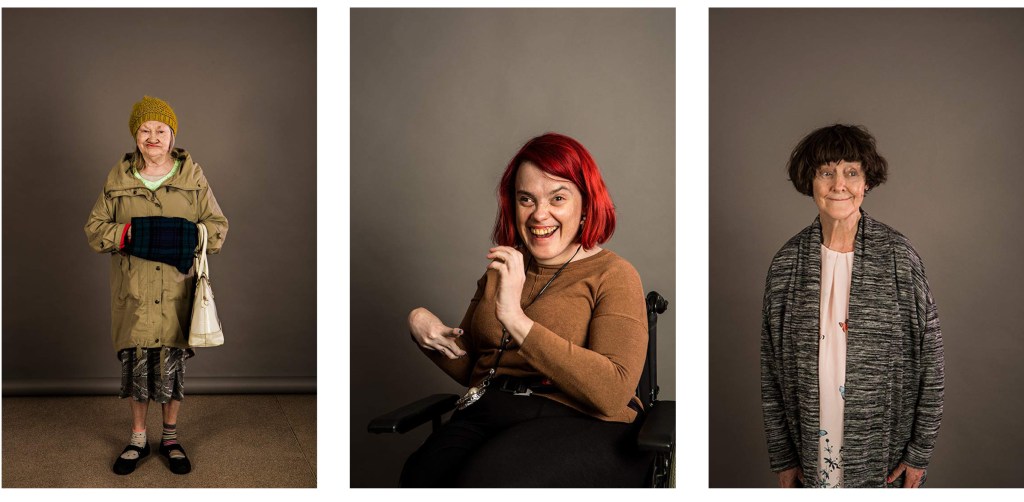
Below are some examples of work I have shot in collaboartion with a charity who work with people with Autism and learning difficulties. I spent a year on and off photographing around 200 people who live in care, the carers and people within the communities they live.The project was called Self and the idea was to help both the sitters and the wider community to question how they see themselves and others within the community.Done through exhibitions and workshops it’s aim was to raise awareness of the discrimination and of course lack of funding.
I did plan to shoot individuals in the rooms they live in with all there personality indicators to give context but decided in the end that a plain and simple background all the same would equalise/neutralise the subject and allow the personality of the sitter to shine through without distraction.I know where my gaze is firmly set with set of images but I have of course had my doubts a to what other viewers may think of my intent outside of the context of the exhibitions etc…..what do you think.
 DEAN BELCHER CRITICAL RESEARCH JOURNAL