
I wrote this piece after Steph’s lecture but before I read Andy Grundberg’s piece in the New York Times.
However now I have read the task I think I have answered those questions below and have added reference to Grundberg where I see similarity in critique.
I too was one of millions who subscribed to National Geographic in the 90s. It’s funny because on reflection I think it was all part of a “package” of re education for me. Growing up we had no books in the house and I can never remember seeing newspaper or magazine other than the ones I brought home later as a teenager.My upbringing was not really a NG subscribing one.
When I started out on my career as a photographer I saw this self learning as essential and National Geographic became part of that. I learnt about stuff but like many photographers the images of most publications are the most important to me. I absolutely loved the aesthetic of the imagery and dreamt of being able to shoot similar.I still do love a lot of the images but quickly realised this was a definite National Geographic or as I thought then and now a very American (U.S.A) way of looking at the world aimed at a specific audience.
Quite idealistic, aspirational perhaps a little safe and unquestioning.Perhaps not wanting to upset its target audience.
As a cynical young Brit at the time who questions almost everything I quickly got this but continued to subscribe until I found I didn’t pick it up so often and barely read some issues. I guess that world view became one I didn’t subscribe to as my knowledge and visual language grew.
I also travelled to America a few times during that time and realised I’d been sold a bit of a pup.
Don’t get me wrong I love visiting the US but I realised National Geographic had sold me a beautiful slightly sanitised Kodachrome version a bit like the movies.
On a similar note I find it quite difficult to watch the Nat Geo TV channel, it always seems a little too much entertainment based, just not in depth enough on most subjects, kind of skims the surface.
In wielding this much power it is easy to see how come it’s influence on how many people believe and see the world according to the National Geographic.
I agree with Grundberg when he says little has changed since the magazine became more targeted at a mass market and Gilbert Grosvenor the editor in 1907 introduced a more visual, image led publication resulting since the 1950s in the almost trade mark national Geographic look without progressing much since.Whilst looking great it’s become a staid visual language that seems a little old fashioned.
This image below is a good example of an idealised version of what we are meant to believed loving owner having fun with his dear pet elephant.I’m not going to say for fact that it is the case but my immediate thoughts are that it’s quite an unnatural position for an elephant to be in and reading further realise that the elephant is a retired logging elephant which most likely was beaten in order to work a very hard life for its owner, again there are of course arguments that the owner himself is put into an awkward position to save himself and his family from poverty so I make no judgement other than the one that National Geographic paints a picture of idyllic bliss which is probably unlikely to be true.
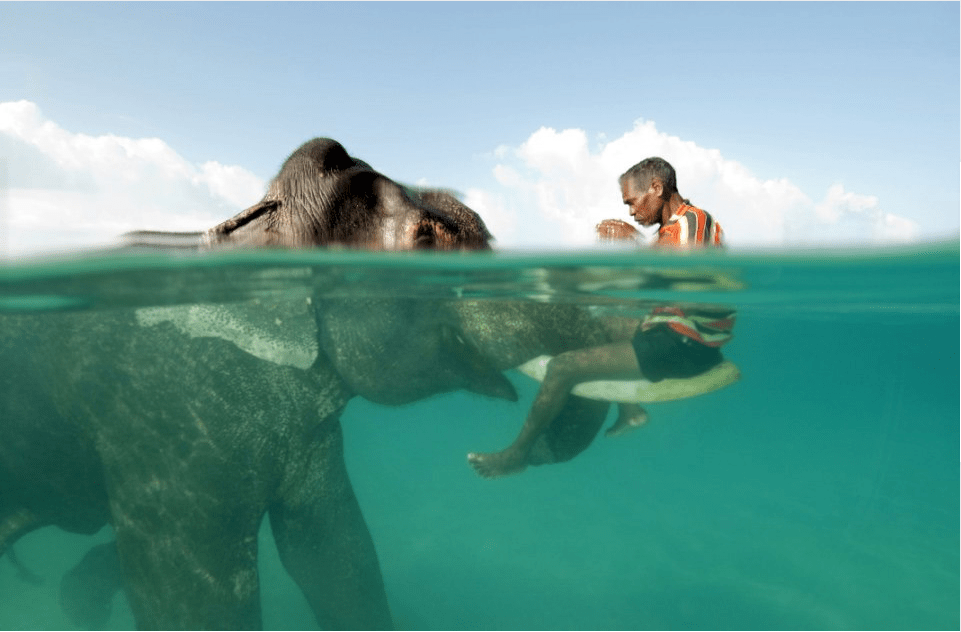
Image by Cesare Naldi
Where as this image below strikes a cord and appears to be more real, we all know that the vast majority of an iceberg is under water and that the plastic crisis is only the tip of the iceberg when it comes to matters of pollution, or maybe at least we as humans have only the data available that may only in actual fact be only the tip of the iceberg. Either way, it illustrates the point well and for a change the literal visual language of National Geographic serves the purpose well.
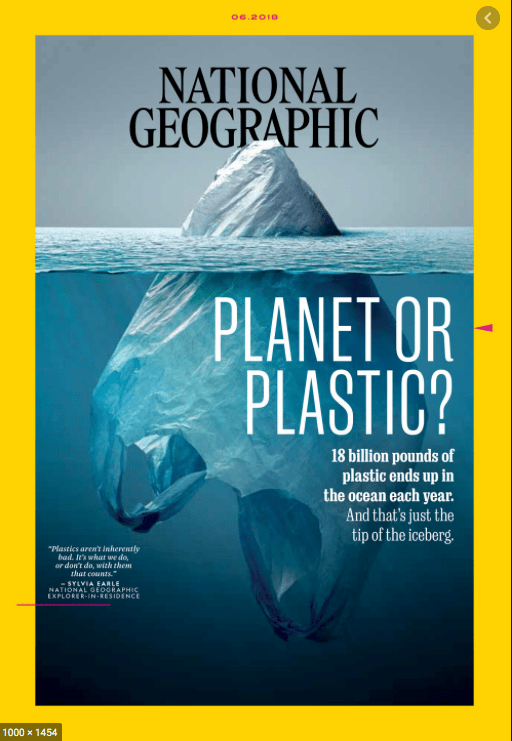
National Geographic cover, photographer Jorge Gamboa
Moving on….
As part of my practice I have travelled well and produced travelogues of around 45 cities worldwide.On revisiting these images I realise that I have naturally and possibly unintetionally but all the same avoided the stereotypical imagery as portrayed in National Geographic I once so dearly wanted to shoot.Whilst I still see some aesthetic similarity in the colours it is rooted very much in the vernacular and banal and has more in common with the work of Stephen Shore than Steve McCurry.
By the very nature of its context which is to help illustrate a CD sleeves art work It’s intent is not to show the picture postcard image of the city but to try to show the ordinary with humour and curiosity to show the underbelly, the other but not necessarily in gritty photojournalistic way, somewhere in between.Even the the covers which depict the DJ/artist only give a hint as to where the album is based from on very few if any would it show an obvious landmark.
Within this context I do have to consider the power I have as a photographer both with the viewers and the subject matter.I often shoot people on the street and most will know I am taking there picture however not all will know the end product or context.I have to consider this when taking the picture and also when passing on my edit to my end client. As part of this same project I photograph people have a great time in situations where there behaviour is not there normal everyday state, in nightclubs and festivals where they are often reaching euphoric states sometime intoxicated, often in outlandish clothes, sometimes even little in the way of clothes and whilst in the moment they play to the camera and are aware they may live in a situation outside of this context where this behaviour is less acceptable and they do not want to be shown this way.
Now whilst everybody is made aware of my presence and legally the images can be used my own ideologies have to come into play as to where this power is used and how.
I’m representing a moment in time that is fun, outrageous at times and most often I’m asked to make sure “they”make it into the artwork,I have no control over this part from withholding images in the supplied edit but I often have to think how will that look in 5 years time how will they feel about that then so whilst I have a lowish barrier one does exist that I do not cross in thus context.
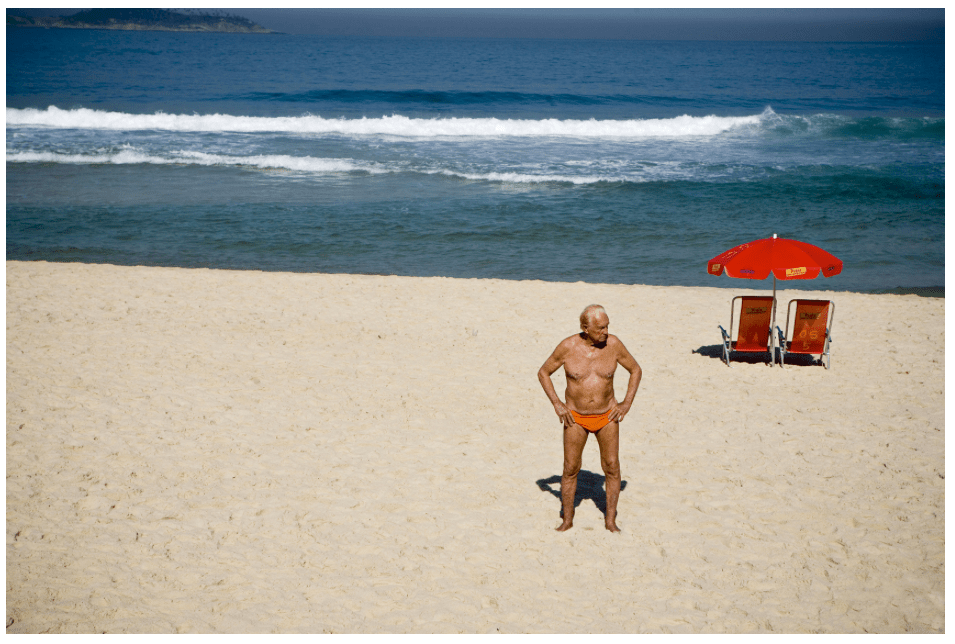

Andy Grundberg’s (1988) article A Quintessentially American View of the World (Links to an external site.), published in The New York Times.
 DEAN BELCHER CRITICAL RESEARCH JOURNAL