Journal

FMP PH705,Taking shape

Wendy and I discussed the progress so far and my doubts  going forward.I’ve been working closely with two WMC and have made great contacts, built trust, become friends and feel that my goals of fair exchange can be met. We discussed the work so far and both decided that it is time to move on to the next phase which I think is best suited to my idea and skills. I have pinpointed several people and groups of people that represent the story I am trying to tell .After many weeks honing it down I think I am closing in. I plan to write a proposal to put forward to the club committee,which funnily enough I have been asked to join, this in it self feels like a success as I’m keen to commit to the project and continue my ties long after the end.I will propose I set up shoot days where I can shoot a more set up portrait scenario based on the stories of each sitter and the research material I have already shot.In order to convince them of this I want to be able to offer both the club and sitters something in return. Wendy reminded me of the work of Mark Neville and his working practices which despite knowing some of his work I was unaware of his methods,theses are exactly how I envisaged my work with the club going,I did however struggle to articulate it to myself and others. Since researching the way he works with the communities and people he photographs I am now very much more armed and confident in moving the project this way.I particularly like the way his audience is the people involved first and foremost, how they are complicit in its form and no one feels exploited. I stand by his method of gaining trust and consent, honesty and being totally up front are the only way. The best way to become invisible is to be up close and open in my opinion, it’s how I’ve always worked and most people respond well to it. The best analogy I can think of that you can relate to the idea of hoodwinking ideas is when you use a long lens to sneak images of people from a distance, you will always stand out like a sore thumb more than if you get up close and direct, eye contact and honesty, two way participation is the best policy.The other thing about Mark Neville that struck me that I have struggled with is using photography to actually make a proper tangible change or help solve a problem.He talks about highlighting situations through photography being all very well and yes it does in many cases but in his case it is important the actual end product becomes part of the solution.For instance the work he did in Corby,the end result being a set of illustrated  guidelines sent free (as part of the projects budget ) to all UK councils, housing,planning and environmental  departments to highlight and inform based on real scientific evidence and protocols the issues surrounding toxic waste,decommisioning and new build planning.

I’m not sure my project will result in something quite so profound but getting back to what I can give in return, like Mark I will be  proposing all sitters get a free book/publication,of course a free print of the portrait and as for the club. I am aware the room in which I may be showing this work is an old committee meeting room.Members of the committee would like to see it re furbished, cleared of furniture and used as a local space to encourage more art shows and openings so promoting not only the ethos of self learning but also utilising another space available to the wider community and generating income for the club to stay open.I think by using my pictures ,the stories of the members and some historical context, bearing in mind the club is within half a mile of both William Morris’s house and gallery ,Walthamstow school of art where Peter Blake and Ian Dury taught and studied, not to mention the thriving arts scene we could use the publication to approach the local council or CIU in order to raise funds. If all else fails I’ll paint it myself !

I’m excited to get going, have to wait for Covid lockdown to end but plenty of time to get the proposal and some research done. Also I want to incorporate Topography so will be researching and shooting relevant exterior shots in the meantime.

FMP UPDATES AND THOUGHTS ON SOCAIL MOBILITY

I’m still having doubts as to the merits, imagination and potential to be something of interest but i’m pursuing and shooting as best I can in the restrictive circumstances.

I want to celebrate the WMC or at least the people involved,i’m struggling at times. In particular at the ex servicemen’s club some of the gestures such as the singing of land of Hope and Glory and the waving of Union Jacks to get attention of the bar staff,the lack of any diversity race wise does make me question some of my motives or beliefs in the people I am celebrating here. I think I may be over thinking it and reverting to media stereotypes of flag waving racists when in fact its an older generation who are actually just having a bit of fun in the traditions they have been brought up in. I have no reason to suspect they are at all antiquated with old fashion views that do not fit my metropolitan left leaning views,not once as racism raised its ugly head or even Brexit,I have no idea how any of the people voted and suspect even if the vast majority did once again it would have been reasons beyond racism,not all brexiteers are racist I know.I guess it just doesn’t sit well with my romantic idea of the progressive militant working class, why should it, most people are just trying to get on with their life the best they can and often that as been a struggle,to let loose with a few drinks and a sing song is part of that tradition associated with working mens clubs,I suppose I’m struggling to shake of my preconceptions formed back when I was in my late teens.

I’ve met so many wonderful people i’m almost part of the furniture in this club in particular,so much so I know most by name and they mine. I really do not want to betray this trust.

In contrast the more progressive club is harder to penetrate with a mixture of similar people to Leyton they also have a far more progressive membership that I think are still a little wary of my motives,saying that I do feel that it is moving forward and whilst I have taken less images there I have made great grounds in making contacts and provisionally made loose arrangements to reconnect in December when I plan to start shooting more there. They have abided much more by the covid rules so i feel obliged much more to keep contact to a minimum ,the older crowd have been much more receptive. 

I need to align myself with the younger members and in particular the gay and black members to try and get my message across.

One way I think may be best is to set up a shoot day or two and stay all afternoon once some normality comes back, if it does. Under normal circumstances I would have progressed much further and quicker with the process. This club in particular only opens for Friday and Saturday night events at the moment which usually involve loud music so conversations are strained and mixing between tables is discouraged.I’m now at a point where I think I’m well known enough to push this a little without upsetting the comittee.Which by the way I have been invited to join,I think I may be an asset .

I still struggle with the idea of joining these images up with my story.I’m trying to explore more than anything social mobilty and my journey from a working class background through education and self learning to the lower middle class lifestyle and environment I find myself in now.How I am able to cross both divides and my relationship with both in terms of my own views and opinions and those I encounter and have left behind to a certain extent. Most importantly my relationship with my father,his with his and mine with my own son and my sons with his grandfather,all of which are very different but have a similarity in as much as they are all fraught with a tension apart that is the one between my son and I which I hope and it seems as broken the cycle. We are however all very similar in personality which is interesting.

With social mobility levelling out and possibly on the decline for the first time in decades i’m keen to explore how this as happened  and where all the opportunities have gone.Maybe they have not and we’ve just reached a natural plateau but with what seems like the polarisation of society on the rise in recent years i’m keen to look at it through my own experiences and that of my family.

My experiences are very different to those of similar youth growing up today some would argue the opportunities are more but if that is the case why are a growing and disproportionate amount of people from similar more wealthy backgrounds still more likely to be employed in the top earning professions such as law,journalism,politics,education,the arts,banking and TV.There are still many hurdles and gatekeepers that discriminate either actively or via ingrained stereotypes and traditions that are not being broken down.The so called meritocracy I would argue does not exist and if it ever did is on the decline once more as ways in are about the connections made through social standing either at school (usually paid for) or through parents in the same profession,who can realistically intern for a year in a major city for free without the outside help of others ?

According to Hashi Mohamed in his book People Like Us the gap between the standard of education of private schools and state schools as lessened,admittedly there are factors to take into consideration like the league tables which are easily skewed and schools with an entry exam in the case of some grammar and religious schools which whilst independent are still classed as state and do cream off the best talent.In contrast to which and usually to keep exam result tables at their best some state schools expel troublesome students who are proportionately less likely to attain good grades if any before they sit and in doing so bring the overall averages down.It is So why is it many families pay and in some cases struggle to pay to send their children to private schools ?

Why this huge investment when state schools are closing the gap academically and in some cases superseding them with exam results.The answer it seems is the social currency,it really is worth the money to instil not just that confidence and believe but also the ability to interact with the people from these backgrounds the top professions employ the most,that ability to engage in social situations and use those opportunities to expand the correct networks so allowing very little scope for someone without those connections to penetrate and on the off chance they do,once in to flourish.

There are many many areas to explore as to why and how social mobility does and does not work how it was once seen as a vulgar term or as a betrayal of ones roots,much of which I hope to explore in relation to my story.

Code editing is one of my favourite areas of research and in many ways relatable.Take most social,work or interview situations,without knowing someone’s name,background,social standing,job,schooling first impressions is a very important part of how we immediately evaluate someone’s suitability as a friend or employee or simply the person who we may be chatting to for the next 10 minutes.So apart from appearance such as dress codes the next is race,ethnicity,so lets say we can see past that the next is accent or vocabulary.A child of 6 from a wealthy background with access to books and who would most likely have the time given over to them to read and be read to has vocabulary of around 2600 expressive words and 20-24000 receptive words of vocabulary whereas a child from a poorer background who’s parents or parent are more likely to have less time and money or even the inclination to be able to provide this are substantially weaker in both areas often with a reading age of around 15 months leads to a perpetual game of catch up.Accent of course is a different matter and quite complex also,imagine if you are the child of a 1st generation or refugee family where English is not your first language, not only is their ethnicity,cultural and economical disadvantages at play there is also language and pronunciation. Even within groups of people born and bred in the UK for instance accent plays a huge part in how people perceive you and this is where code editing is very interesting.A lot of people have what they call their telephone voice usually an attempt at a clipped BBC queens English,code editing put simply is an ability to change ones accent ,to have a wide vocabulary and be able to use it to fit in within the current circumstances and surroundings this ability to do this is an important part of social mobility and creating the all important means of fitting in and opening up opportunities.

In practical terms and going back to my methodology I think the only way to get the portraits I want is to set up several portrait days similar to Daniel Meadows did with the Photographic omnibus and offer free prints in return for time to talk and take the images set up in the environment and lit how U see them in my head,very much based on what I have seen in the club and more in keeping with my usual method and practice of environmental portraiture. I just need to convince the committee !

Other areas  I have discussed and need to clarify going forward is how I link this work to my own story. One idea I have is to photograph myself my dad and my son all in a similar way and produce a single triptych that connects us all in one image.

Me in the middle one either side like this image I produced earlier this year.

I’m also toying with mixing black and white with colour images,i’m not sure wh,aestheically I prefer in B/W and some in colour,is that a good enough reason.Perhaps I could use it as a tool to play with ideas around the past and present with some of the b/w being mostly shot in the club that is becoming apparent is a bit stuck in the past and concentrating my efforts to produce the colour portraits in thre more progressive club. 

On Another note I have been thinking of alternative projects just in case, maybe that is a mistake but I always have more than one project on the go as a rule in  any case.

One that may work is a series of portraits of on the ground revolutionaries  and key people important in bringing change via grass roots organisations.

I am very friendly and familiar with Red Saunders who along with Roger Huddle ,SYd Shelton and Ruth Gregory,(also fiends)set up and organised Rock Against Racism, a group that was instrumental in combating and actually stopping the rise of the NF and BNP in the UK at a time when they were on the rise and gaining seats in local elections.

I have many more similar people i’d like to photograph and have access to them through various connections.

During the covid restrictions I thought I might go for a walk and record their story then photograph them again in an environmental portrait setting and style outside.

Rest easy Chris Killip

I can’t claim to have ever met Chris Killip but like many students of photography and photographers especially of a certain age I am very aware of his work and through his work I have met him a little.

He covers the area of work I never really engaged in myself but dreamt one day I might and whilst I embark on some similar subjects I barely scratch the surface compared to the way he got to the heart and soul of his subjects.Spending years getting to know the people but hastily collecting images of times and people who where quickly disappearing, some for ever.

He photographed a time and to certain extent a place I grew up intone I was desperate to leave, one I miss a little now I’m older and the alternative is not always so great. I’m probably romanticising …something Chris could never be accused of but what I do like about him and he said this was he wanted to create a sympathetic look at what what he shot not a cynical, disparaging one. Some might say that is too soft, too romantic and maybe the approach of other documentarists was more effective.I’ve never agreed with that notion and I’m glad I discovered his work.

My favourite quote of his is

“History is what’s written, my pictures are what happened.”

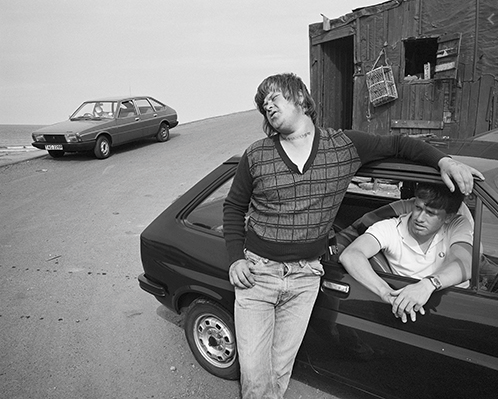
My favourite image and one that really took me a long time to understand why I liked it is this one, it really was one of the images that made me decide I wanted to take photographs .

Killip,C Bever,Skinningrove,North Yorkshire. 1980

Influences.Chris Coekin and Daniel Meadows

I first came across the work of Chris Coekin via my tutor Wendy Mc Murdo.It’s been a real help in shaping the methodology of my FMP. I was starting to doubt the viability and validity of the subject and how relevant it was to the story I want to tell.

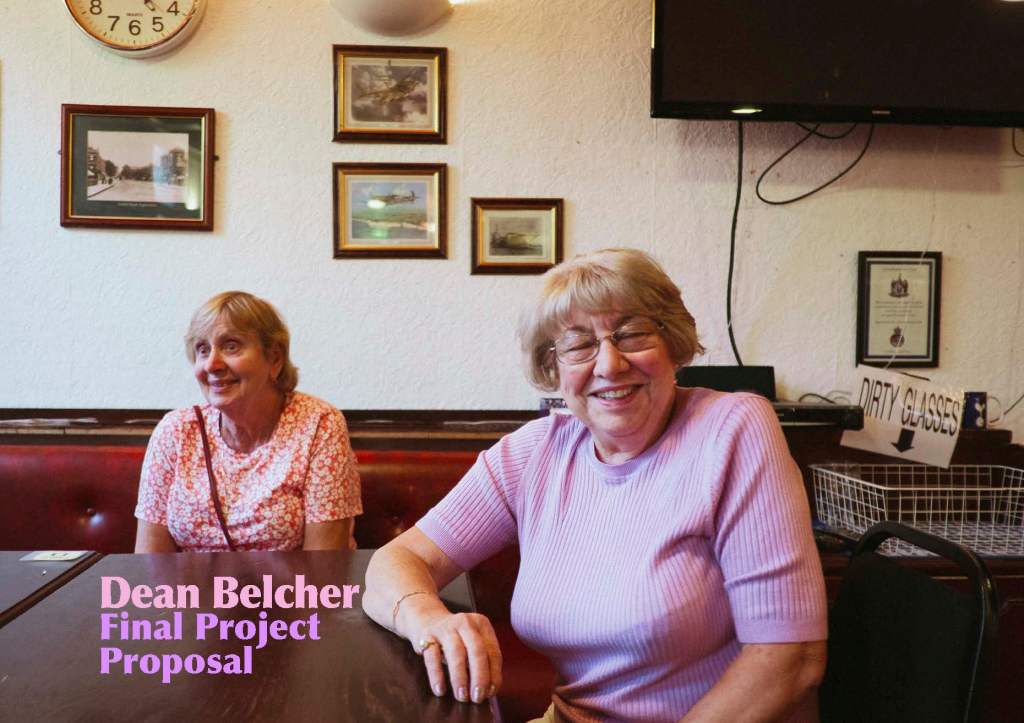
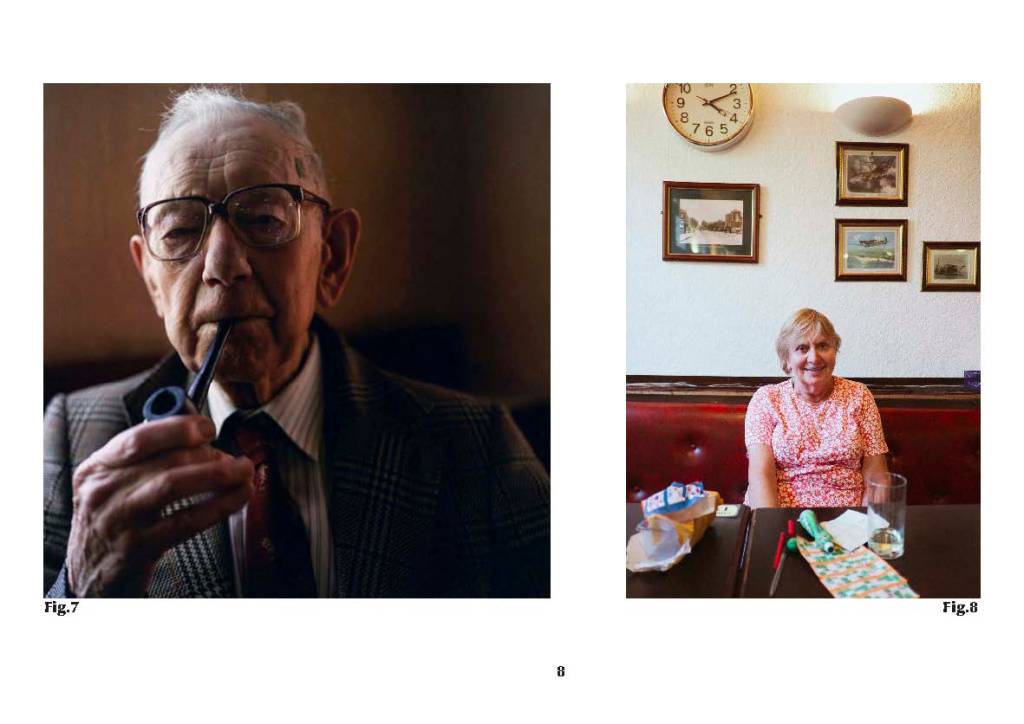
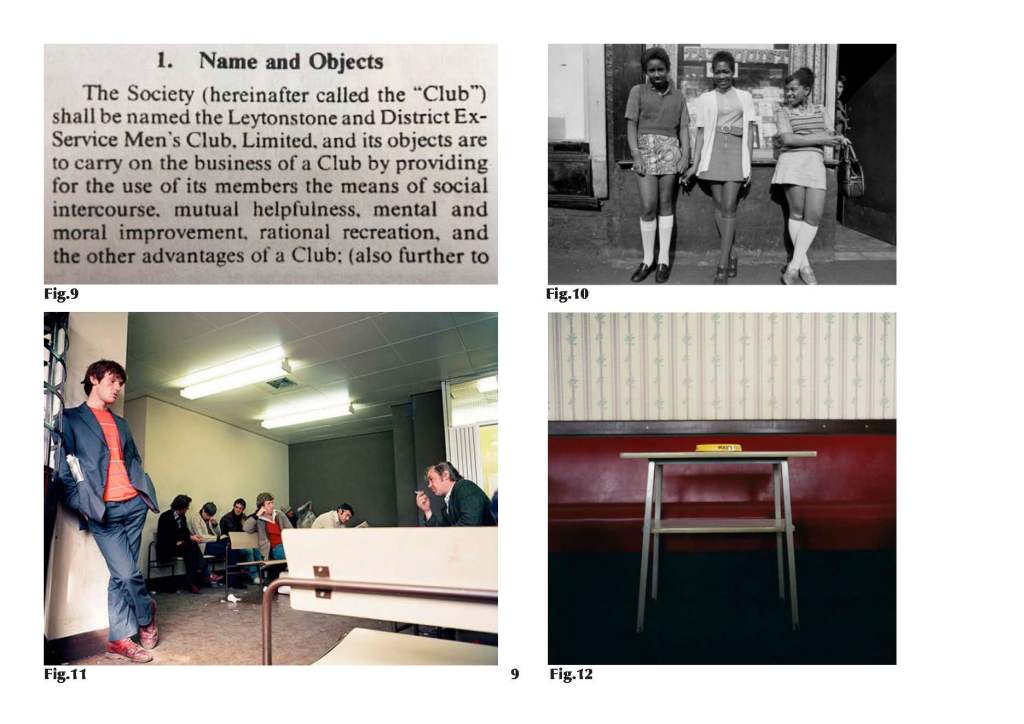
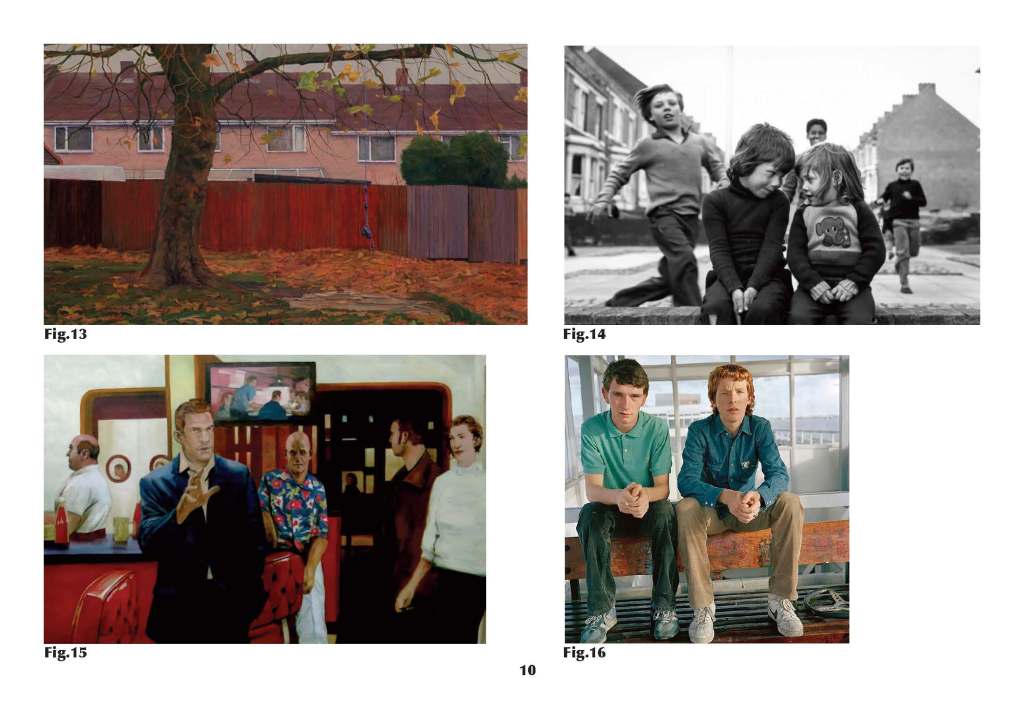
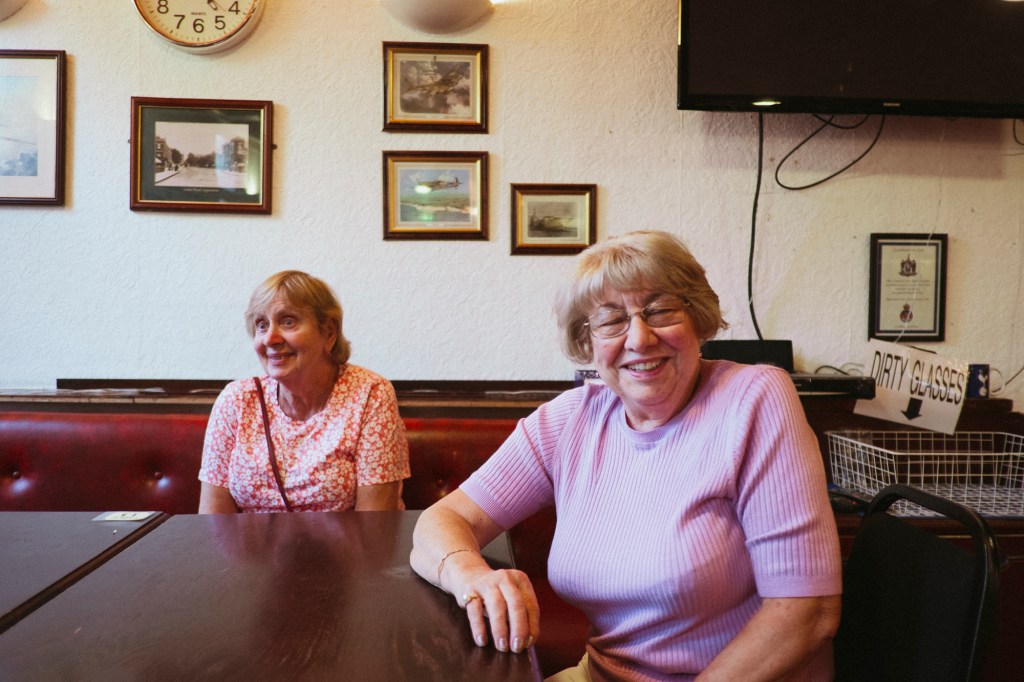
His work around Working Mens Clubs Knock Three Times in particular resonated with me.I don’t have years to acquaint myself with the members but having become a member I am finding the process of getting to know people quite easy now and find they are interested and supportive of the idea, what it is for or will end up seems to be the main concern, once that is explained they open up and seem to be very accepting so far.

I mentioned before that I wanted to do a short presentation to the members but it seems Julia the Club president is not keen. Although she as been reasonably co-operative I believe I have some way to go before she is totally convinced of the project and motives.I think she wants me to bring something more quicker.I’ll work on it.!

In light of this and the responses I’m getting it’s now time to spend some time actually shooting more than just some of the found images. I’m sure I will use some of these but as a tool to get to know people they have been of most use.My friend Peter Dench who is a renowned documentary photographer explains that many times he as wasted frames and rolls of film getting to know people, people in charge asking to be photographed,people who perhaps are not relevant to the story, that will never be seen but by doing so sets them at ease.I have had to employ this method myself before and I see it as part of the process until you are accepted, the real project becomes apparent people understand and start to forget about you being there.Becoming part of the furniture.Often recommending other useful people and places.

It’s true to say that by being upfront and close you often blend in and become just there by being honest and open as opposed to trying to sneak shots or use long lenses, often by doing this I find you become much more visible, the images say very little and there is no relationship between the subject and photographer.

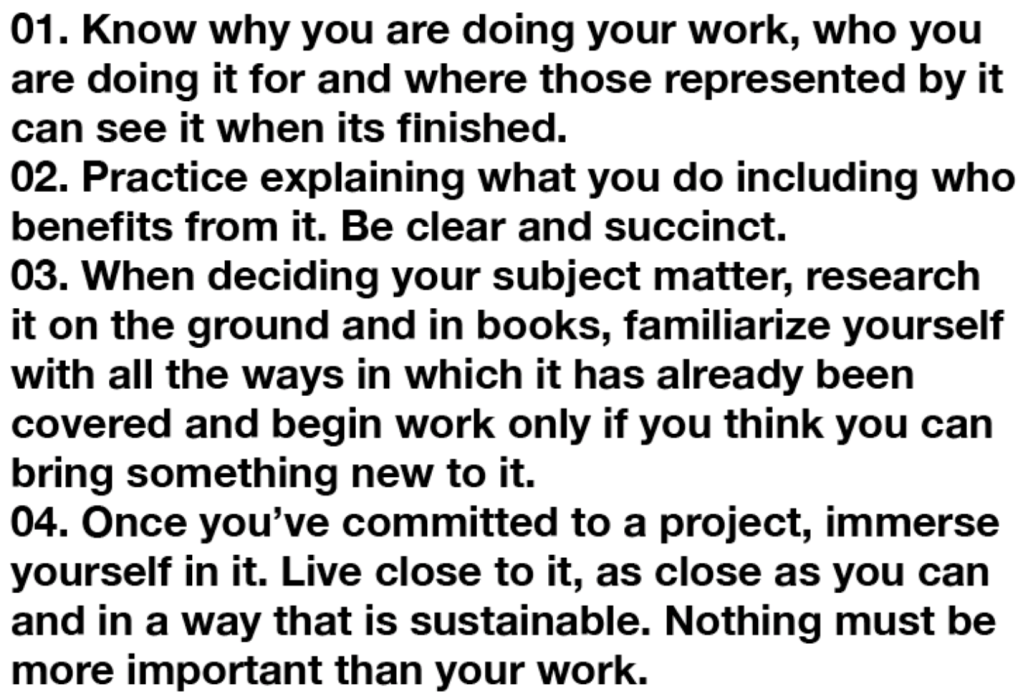
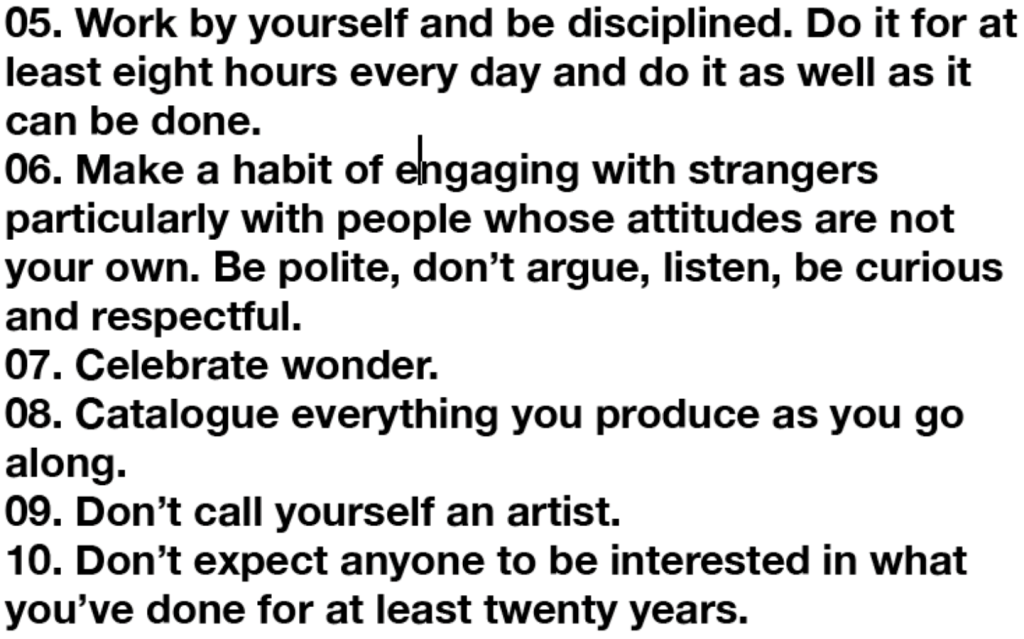
Daniel Meadows has a good set of rules which I think are very helpful.

So getting back to my methodology. I will continue to photograph found/reportage/candid images and alongside that as planned I am starting to formulate the ideas around some set up environmental portraits, some influenced by the candid images much like Chris Coekins set up images but in my case it will be less about recreating them as he did and more about using them to influence a portrait with some elements included.In doing this I will be giving my interpretation of how I see the subject.

The next time I plan to go is this weekend where I will continue to meet new people and also speak to the people I have already met and start arranging times to sit down and talk to them,record the conversation and get started on the portraits. Once I start this point I know it will encourage me to continue and the project will start to flow. My doubts I’m sure abated.

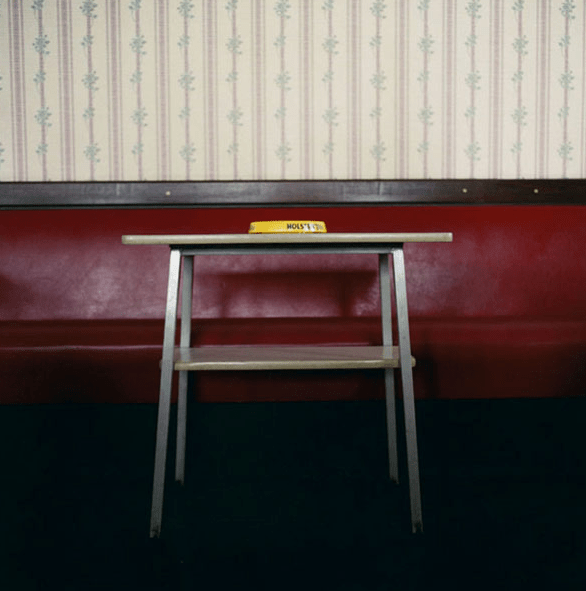
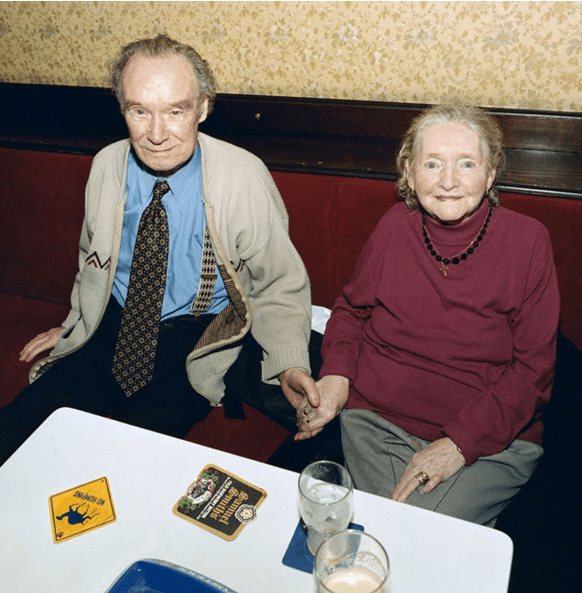
Coekin.C Knock three times 2006
Coekin.c Knock Three Times 2006

FMP PHO705

Ways of working and methodology .

Obviously as soon as I have submitted my FMPP I have begun having doubts as to the validity of the project.What and I trying to achieve,am I really that passionate about my chosen subject.

The answer is yes there is and yes I am,I was just having doubts as to whether I could pull it off.It’s been slow getting started.

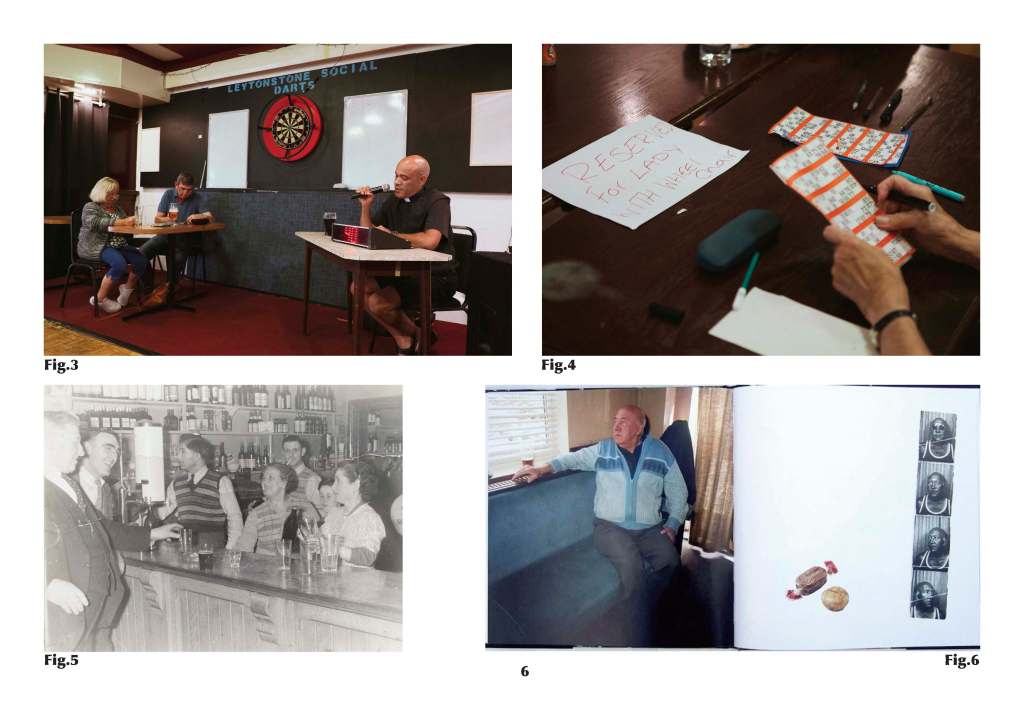
Covid 19 restrictions have meant that both clubs are opening under very restricted rules, no regular music nights, sporadic entertainment ,no dancing, minimal moving about and early closing as restricted an already small audience. I’ve been going to the club as often as possible trying my best to get my face seen,bingo night’s, cabaret evenings and choir practice,’m getting there but it feels slow.

I have a plan,I’m going to ask Julia and Behzad at Walthamstow Trades Hall if I can present a PK to them or possibly I’ll just get up on stage and talk for ten minutes with slides then ask anybody willing to talk or have their picture taken to come forward.That should get things moving.

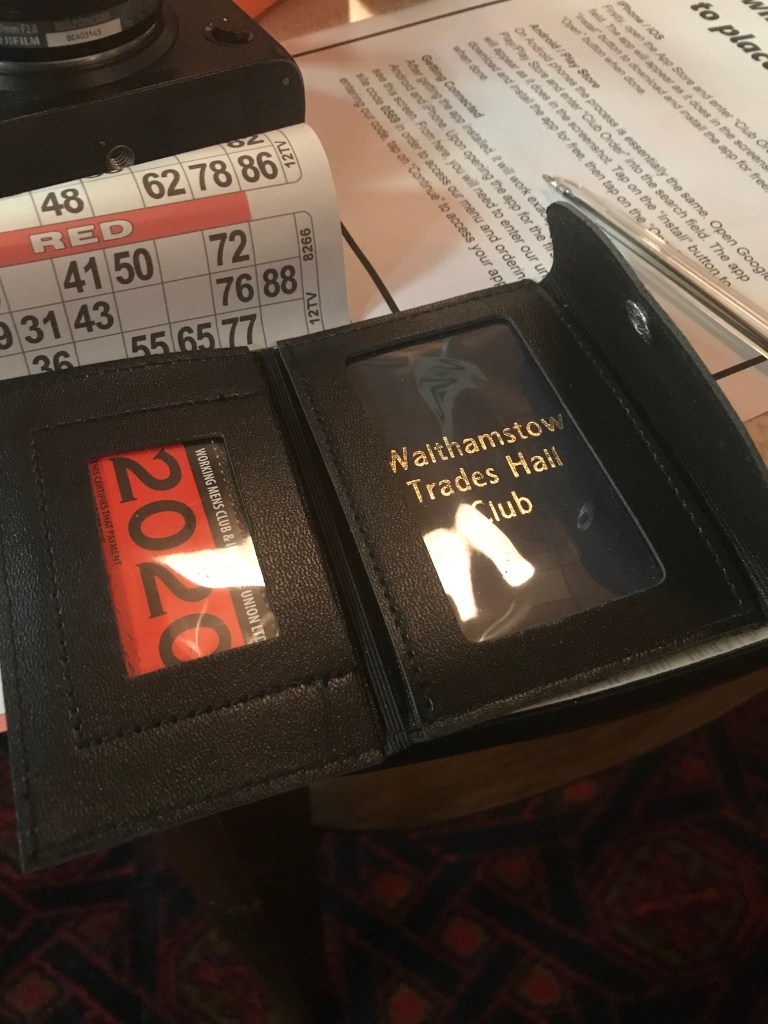
I became a member too.It’s just like the one my dad gave me on my 18th,just need the Tankard now. (check out my previous post ,you’ll know what I mean).

I sent him a picture of it,’m not sure what he made of it but I will be talking to him soon, he’s very deaf so its text or face to face …..

PHO705 FMP Beginnings

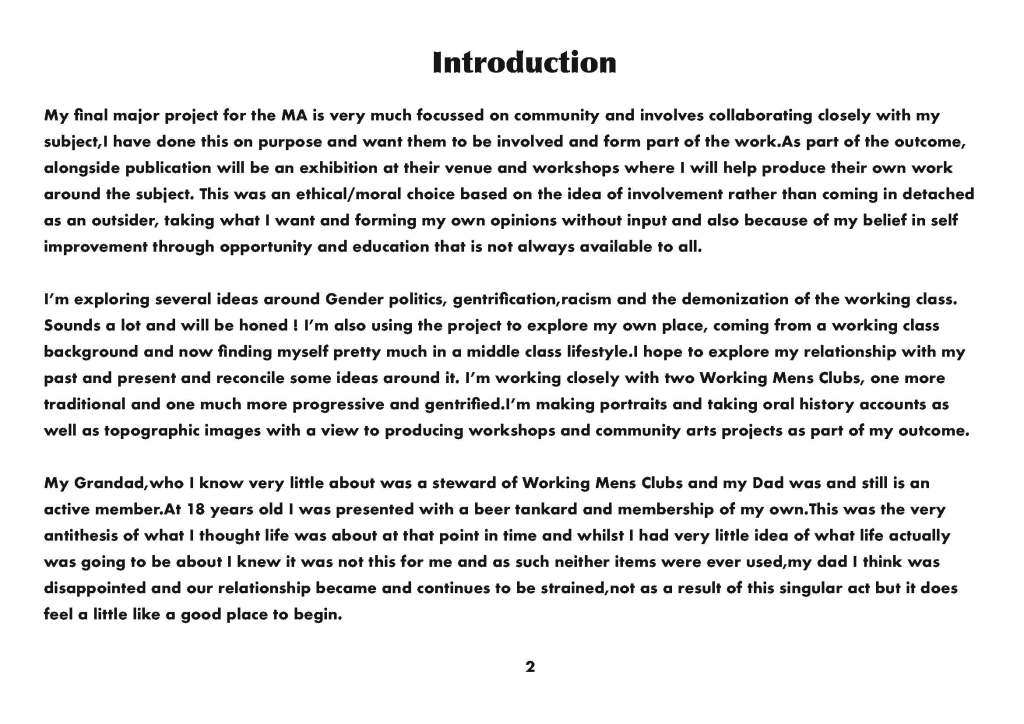
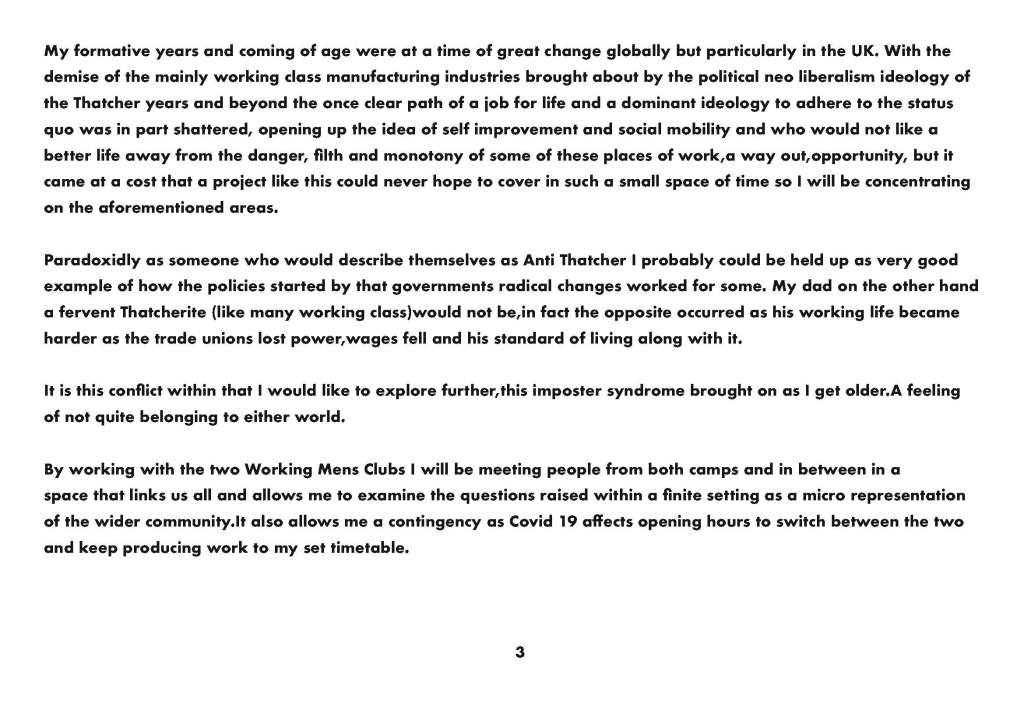
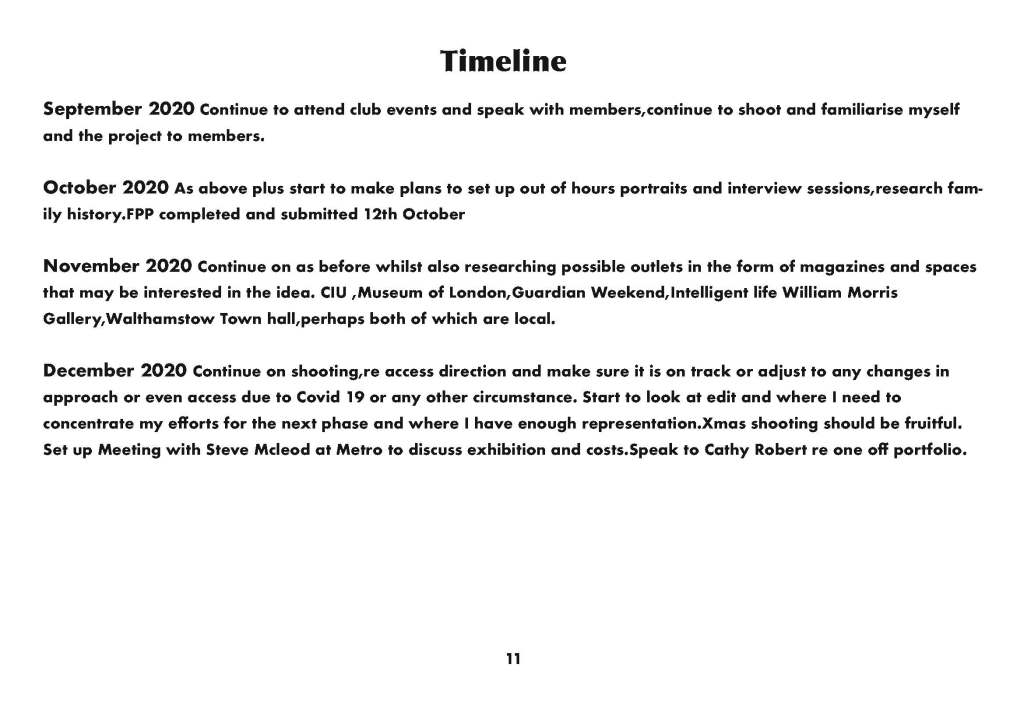
Wendy and I discussed the initial ideas around my proposed FMP.I mentioned how I felt it was a natural progression through my previous modules work and a result of learning outcomes. Many of these ideas stem from ideas I have had for many years,it feels great to start to actually formulate plans to execute them,this being the first of many I will realise in some form. Interestingly I now realise some of these ideas will only benefit from time and in many ways i’m glad I did not attempt them decades ago.Whilst not being directly autobiographical this one in particular is very much rooted in my upbringing and life experiences. I plan to work with two working mens clubs both in different locations and both that reflect different demographics,both reflect different times of my life . There is so much to write about but briefly I want it to be a celebration of working class life but also a look at how I personally whilst still identifying as such made a conscious decision to leave that world a long time ago,probably starting earlier but using my 18th birthday and the gifts I got at a springpoint.I’m looking to explore my relationship with both worlds and how I find it difficult to straddle both mentally. How it has affected my mental health ,my perception of myself ,self doubt and the notion of dominant identity.

Wendy recommended some practitioners working in similar fields who I have researched Chris Coekin and David Moore being two that really have helped me to start to focus the project from being an idea that was wide spread in the outcomes I was trying to achieve. There are so many parts of the puzzle that lend them to telling my own story I’m exited to get going,even down to fact that both places are places that coincidently relate to my early life and also my fathers before we as a family left the area,I had not really given them much thought before they are just local to me now,I think it was meant to be.

I had made a start shooting previous to our meeting and will continue whilst at the same time developing the methods . By the time I meet with Wendy again I will have made this succinct plan based on extra research and will have more images to show.

PHO 703 The Amazing Journey

The MA so far but especially this module as been a real interesting journey,both literally  and figuratively.

Following on from last module we experienced like a lot of the world a full on lockdown on movement due to the worldwide Covid 19 pandemic.It became a time of reflection for many,including myself and also a chance to look and change either by choice or necessity the way we look at the world around us and produce work.Our worlds became a little more localised and insular,I hope not for too long.

I started this module by cycling from my home in East London here in the UK to all the professional football stadiums in the Capital.Partly as an effort to get fit but also to explore my city in a way that is unlikely to be available to me in such a way again.The streets were all pretty much deserted of traffic and the weather was unusually warm.

By setting out with little intention other than to reach my end point I started to explore the notion of the Flaneur and Psychogeography.Both ideas although similar are areas I intend to explore further.

PSYCHOGEOGRAPHY

Psychogeography was defined in 1955 by Guy Debord as “the study of the precise laws and specific effects of the geographical environment, consciously organised or not, on the emotions and behaviour of individuals”.

It’s a method of exploring cities or urban spaces deeply linked to the Dadaist and Surrealist movements it employs a method of drifting or the Derive a term coined by Ivan Chtcheglov close to the idea of the Flaneur but without the elitist connotations.The idea was to allow the space to guide you instinctively,to take you off the beaten track,to make you aware of the urban landscape,to really look and feel.

Situationist International was the group most associated with the idea and was made up of several theorists and artists who amongst many things (usually whilst drunk) redesigned maps of Paris and other cities by cutting them up and reconstructing them the main premise being to free up the city from any constraints,to seperate the traditional Euclidean values in architecture to help separate art from its surroundings.There was to be no no-go areas.

In modern times many writers have used this method as a means to write about cities,Will Self, Peter Ackroyd in his wonderful book London The Biography and Ian Sinclair.They all adopt a very non linear approach influenced by Psychogeography.

Unconsciously I have for a couple of decades followed this method of “derive” or (drifting) through cities whilst on assignment.I have produced travelogues of 45 cities in this way without realising it was a recognised method of working.Turning right out the hotel one day and left the next,allowing the city to take me deep within to quote DEbord in his book.

“In a “dérive” one or more persons during a certain period drop their usual motives for movement and action, their relations, their work and leisure activities, and let themselves be drawn by the attractions of the terrain and the encounters they find there… But the dérive includes both this letting go and its necessary contradiction: the domination of psychogeographical variations by the knowledge and calculation of their possibilities.”

Going back to my own experience with the cycling I used some of these principles by allowing my self a general direction to head towards, i.e. my end point but also not following the strict rules of my GPS map, so allowing myself to be drawn towards places newly discovered to me in a City I thought I knew well.For example in looking for the Woolwich Ferry to cross the Thames I took a slight deviation for no other reason but to look and discovered a foot tunnel under the river I didn’t even know exsisted,which I subsequently used.As a result I engaged in conversations with people I would not have done and saw things that have inspired and informed new ideas to perpetuate the photographic journey forward.Of course it also was very cathartic and gave me space to really look and think .

By using this method I also invariably arrived at my destination from a totally different approach than I would have done by following the recommended rules,the back end,the none shiny part that football fans rarely see.Overgrown and unkempt,like the back end of nightclubs and hotels.Glamourous on the outside with inner works that are functional and sometimes neglected.

Added to this the quiet,in the deserted surrounding streets they became monoliths in a dystopian landscape almost like abandoned places of worship or abandoned gladiatorial stadia of an ancient time past .When usually they would be surrounded by the hustle and bustle of match day,the traders selling the religious trinkets in the form of scarves and badges,programme sellers pamphleteering the words of the god like heroes about to do battle,the local shops selling fast food and ales…not much changes.

The resulting photographs shot on my iphone were then published on Instagram as a series with a commentary written as a “Stream of consciousness” to quote Alexander Bain “to depict the multitudinous thoughts and feelings which pass through the mind”.I think it suits the method of working I adopted for this project.

I produced a dummy fanzine as a prototype to get printed at a later date and to also gauge feedback from my peers,tutors and friends,the result being overwhelmingly positive,attention being payed to the method of capture on my Iphone in particular and the idea in general.

FOOTBALL AND COMMUNITY.

Visiting the Stadia in such circumstances it struck me how all of them are or perhaps would have been in the past such a large part of how the surrounding communities developed both physically and figuratively.Often starting out as patches of grass played on by  men predominantly made up of teams formed through local industries and factories,it was a very grass roots,working class pass time a way of bonding outside of work in close knit communities that worked,lived,played and holidayed together,annual works holidays where the whole place shut for a week was common place from the years after WW1,a time when after nearly a century of the industrial revolution the rights of workers were slowly being formed.

It’s interesting to see today that many of the stadia have been built up from a patch of grass to a few seats to huge grandstands and arena landlocked by houses peaking through rooftops as gentrification and popularity gained.

It’s been mentioned on more than one occasion by peers and tutors that my work as a nostalgic feel to it. Initially I was appalled at the notion,I see my self as progressive,influenced by the past not nostalgic in the normal sense of the word.I needed to explore further the notion of Nostalgia in the wider context of photography and art.

NOSTALGIA.

An affectionate feeling you have for the past, especially for a particularly happy time.

nostalgia in British English

(nɒˈstældʒə  -dʒɪə)

NOUN

1. 

yearning for the return of past circumstances, events, etc

2. 

the evocation of this emotion, as in a book, film, etc

3. 

 longing for home or family; homesickness


Nostalgia beyond the noun as described above as always been present,we can cherry pick the good parts of the past but cannot truly predict the future.More so than ever though we seem to be at a point in time where looking back is more popular than ever. Partly due to easy access via social media and also a trend in repurposing and buying up old photography collections but why is the trend so prevalent.

Knowing history is important in informing the present and future however again through social media more now than ever we are all able to invent or reinvent our own nostalgic version and this can be a problem.

Or as Karl Marx said “History does nothing, it ‘possesses no immense wealth’, it ‘wages no battles’. It is man, real, living man who does all that, who possesses and fights; ‘history’ is not, as it were, a person apart, using man as a means to achieve its own aims; history is nothing but the activity of man pursuing his aims..

“History is the version of past events that people have decided to agree upon.” – Napoleon Bonaparte

Photography as often been used to prove the truth of a matter.However with careful use of filters,editing and curating it can be used to recreate a false sense of Nostalgia and truth.

It’s true my images do have a “look” about them(i’m of a generation of film users and often process with a analogue look in mind) and I am interested in the history of the subject matters but I’m only interested in that as a means to explore how they play their part at present and also the future.

Nostalgia as been used by people in power to influence us numerous times over the centuries,often in times of uncertainty when we may be yearning for what we see as better times (again a picture painted selectively).

Nostalgia is used to sell ideas and products from Brexit,fashion and music to crisps and beer,take for example Tyrells crisps or back in the 80s Courage Best Bitter,adverts adorned with images from the good old days with proper pubs and a proper knees up where you could leave your door open and no one would rob you,(as the popular saying goes because nobody had enough to rob).These are idealistic stereotypes around nostalgia designed to make you relate the products to a better time,a more trusting time,a product or idea you can trust.

I’m a big fan of music that originated in the underground clubs of London in the 1960s but this was not the Swinging 60s which we are told so much about,did it really exsist,the same old photographs from the time are often trotted out,in reality though that was the life of a few wealthy London Elite,not the norm for most.Yet from the select photographs we see you’d imagine everyone spent all their time in and out of Carnaby Street boutiques rather than the daily routines of work and surviving,which was the norm for the vast population.

More recently of course and perhaps more dangerously we have politicians of many countries including our own in the UK convincing us of a better time when we were able to “go it alone” and  “lead the world” all be it as an imperialist colonising force playing on the nostalgia of the 50s and 60s .When we still had an Empire and everything was better and Britannia ruled the waves.Pure Nostalgia cherry picking the myths around immigration and equality.You can see the links to a form of romantic nostalgic  via the advertising being aired at the moment with pictures of busy fishermen and happy workers,elderly couples enjoying their retirement in the English countryside.It may be true for some but it cannot be denied it is a rose tinted view of the world .


EXPERIMENTATION AND NON LENS BASED IMAGERY

This module we have been encouraged to work with mediums we would not usually use,to experiment more and explore re-photography,Cyanotypes and other non lens based photography.

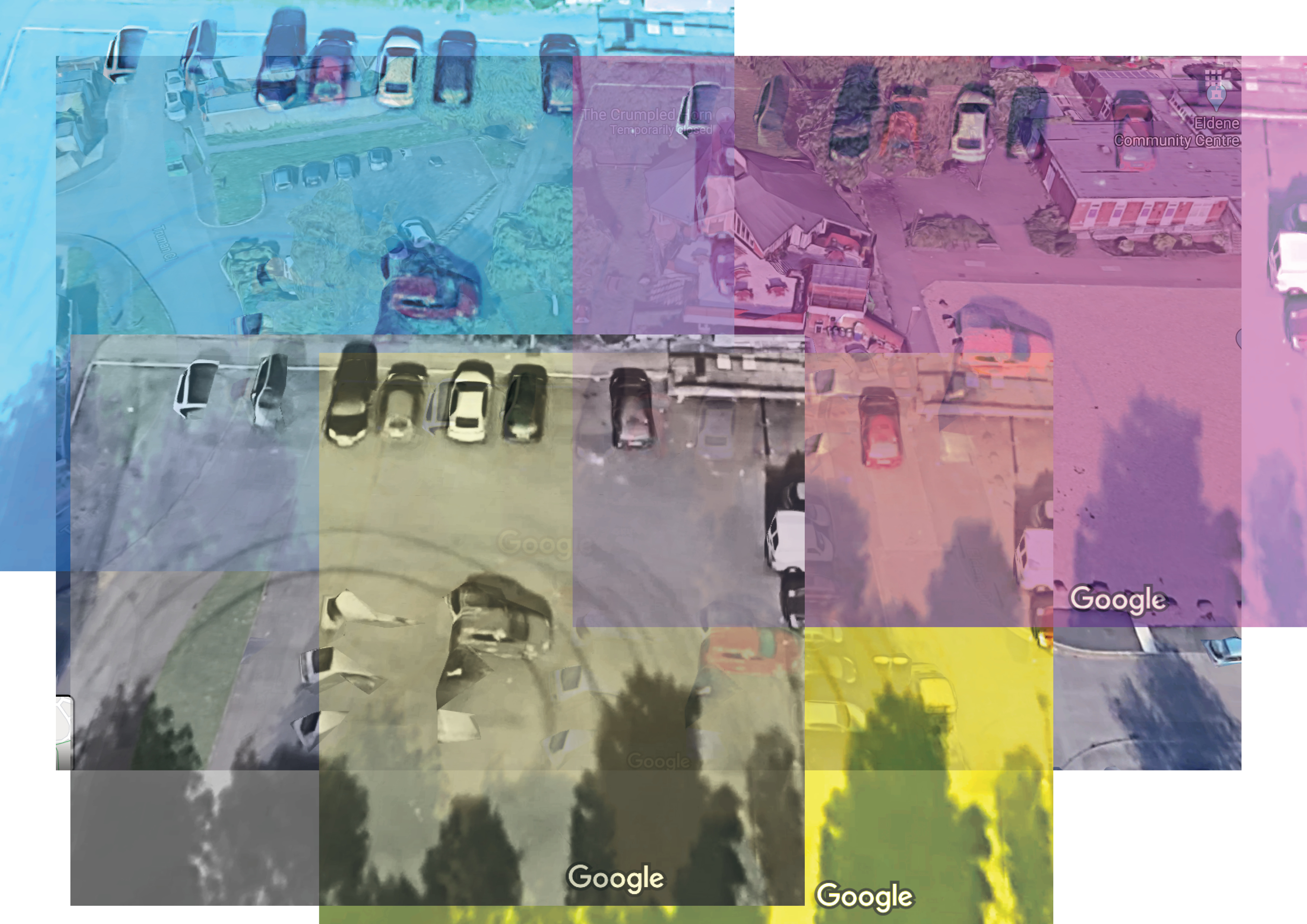
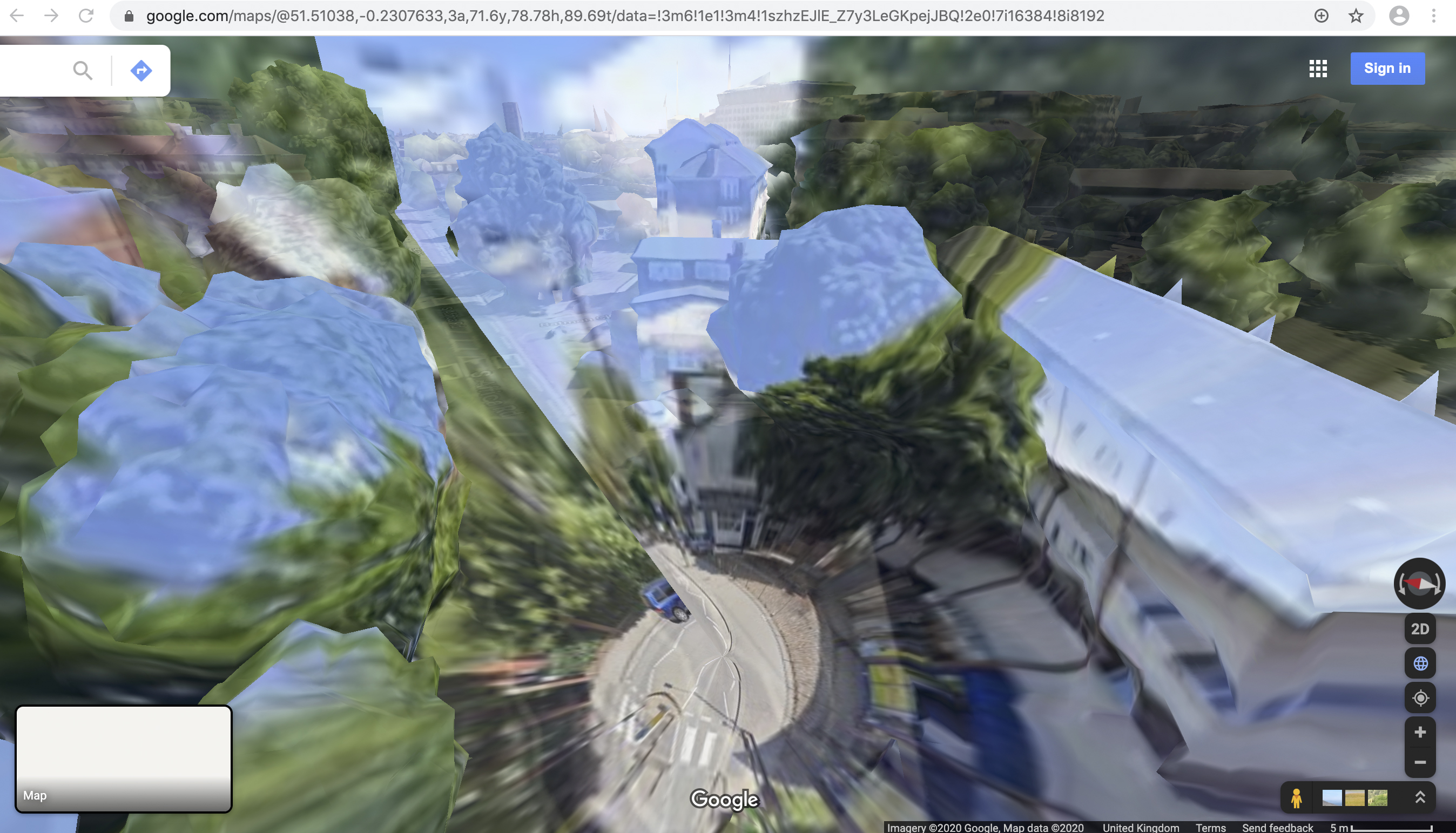
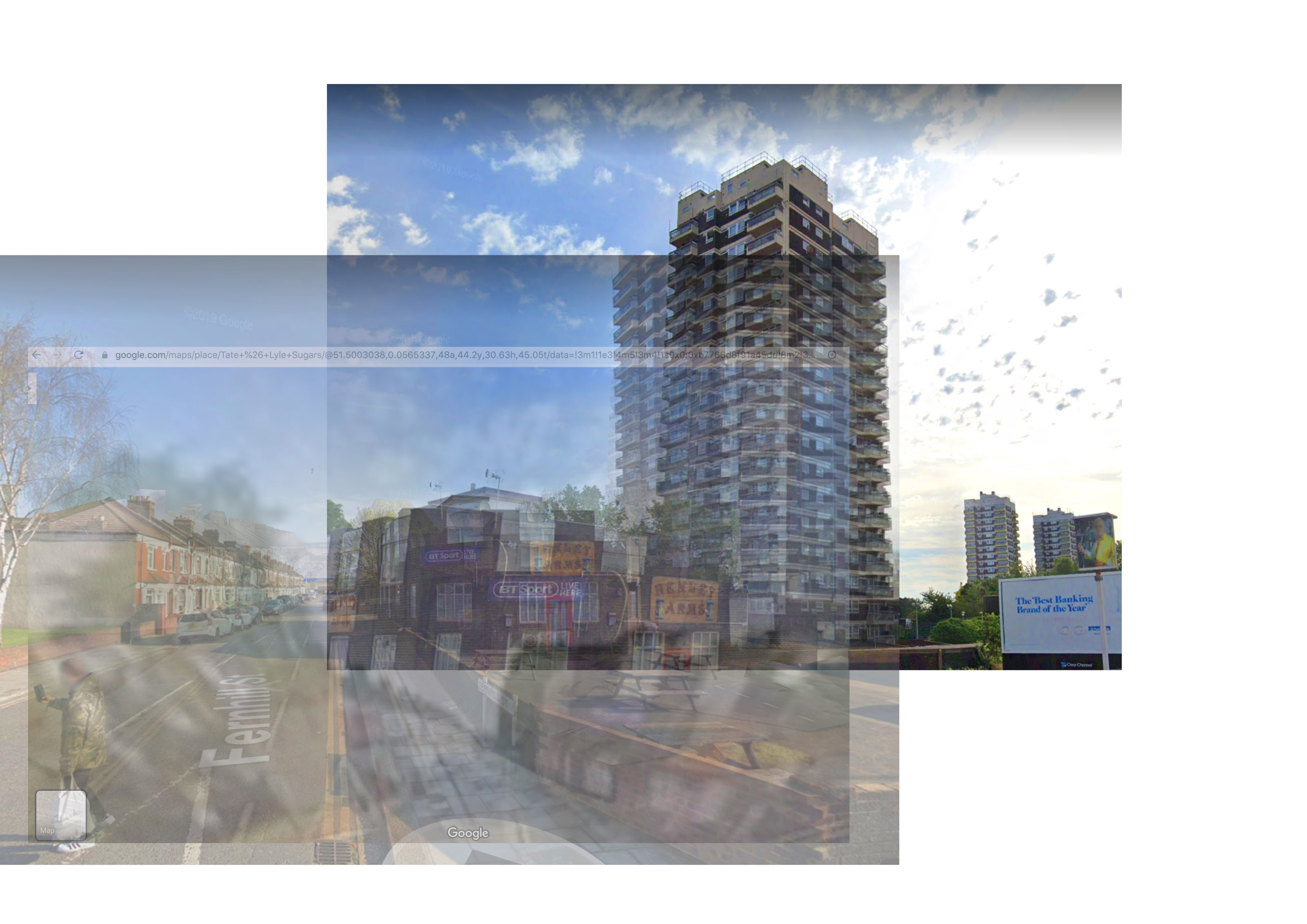
I’ve not always been comfortable with these methods and did not initially embrace or relish the ideas. I experimented with Googlemaps/earth ,initially similar to Arron Hobson who started out exploring  for potential film locations I used it as a means to recce potential sites to photograph as my project moved into locating estate pubs.

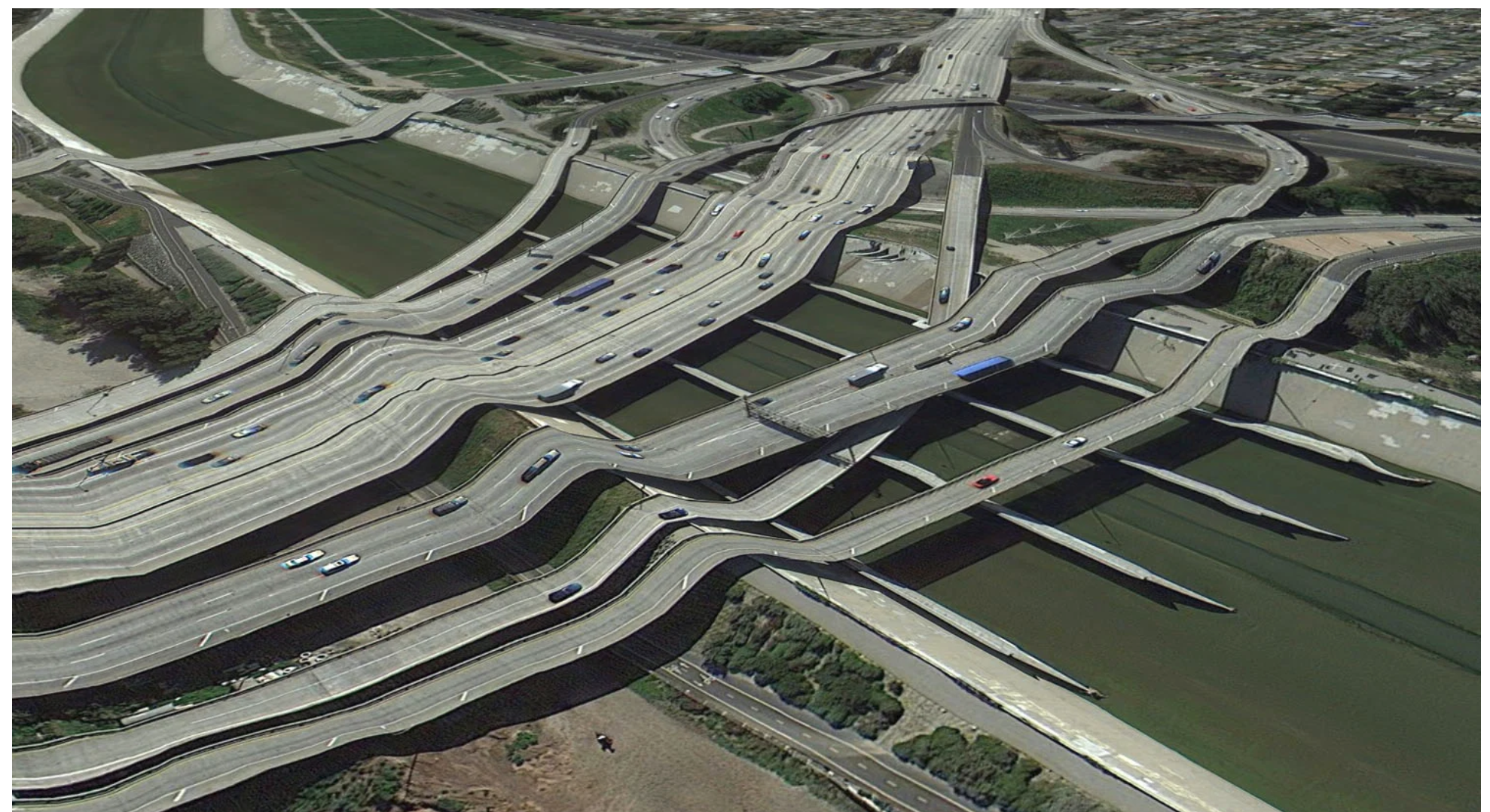
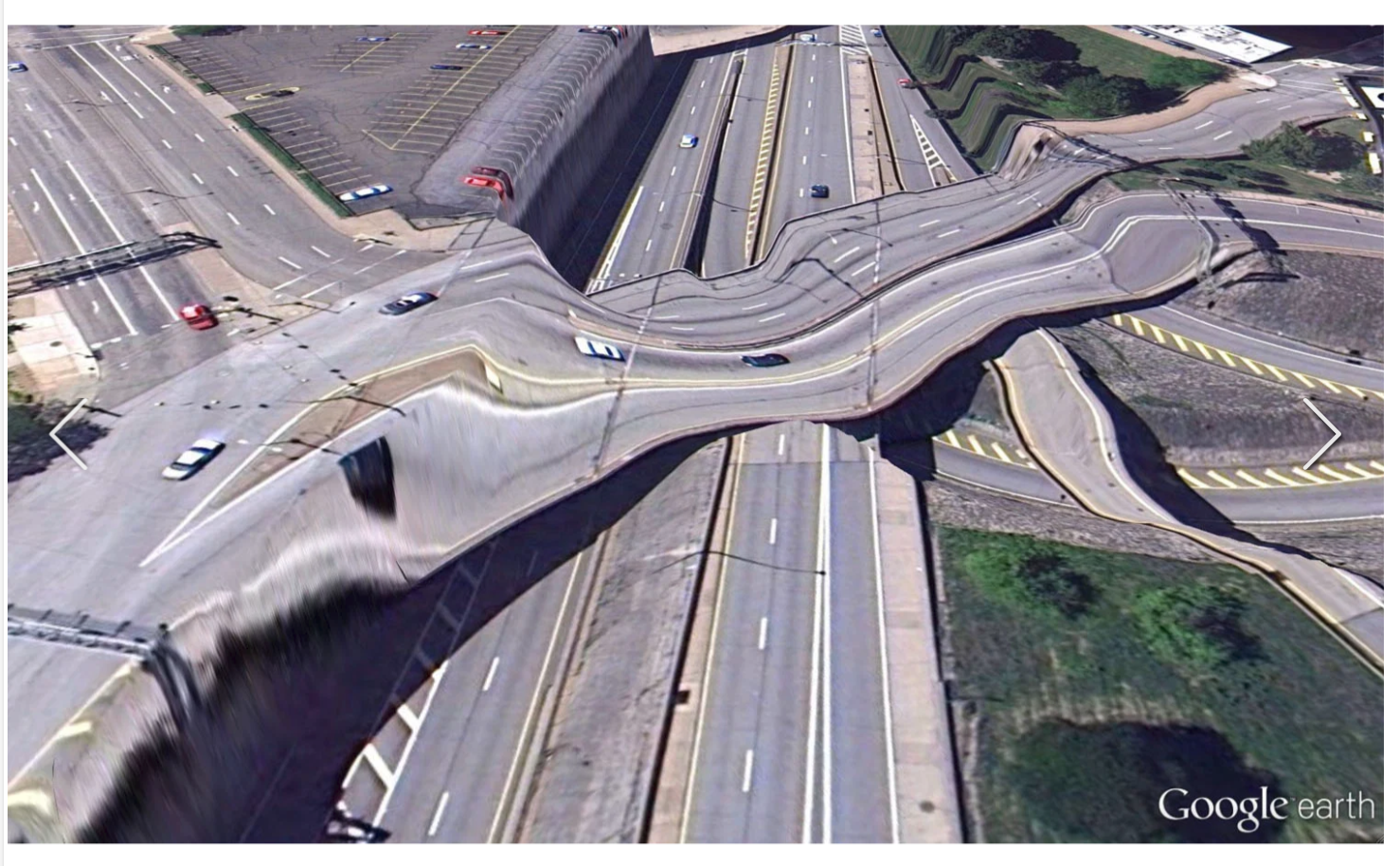
Influenced by the likes of Doug Rickard in his work New American Picture which captures moments in time and in particular Clement Valla who’s work Postcards from Google Earth examines how the 3D interpretations  of bridges and rivers are stretched  and altered to fit the 3D effect of the earth, I actually found I really enjoyed its potential and started to investigate the way google earth plays with time.

By switching from one mode to another say from 3D to streetmap there is a sweet spot that magically within certain elements appear and from nowhere a cyclist or petrolheads making donuts in a car park appear then just as quickly disappear with no trace but the skid marks they leave behind frozen in time.I do not pretend to understand the technology but because Google maps is made up of lots of clips and images time is often out of sync when it comes to constructing the final product,if you search closely you can discover all sorts of moments frozen in time or buildings thrown out of shape only to snap back to normal.This “playing with time ” is the interesting element and something we discussed in a previous module.
untitled 1Untitled-6Untitled-5Screenshot 2020-08-08 at 11.51.09Screenshot 2020-08-08 at 12.03.25

We discussed the idea of Trace in photography and how an image is a snapshot of time and how a photograph or print takes on a life of its own outside of the subject matter.

This taken directly from Susan Sontags On Photography explains ….

“Such images are indeed able to usurp reality because first of all a photograph is not only an image ( as a painting is an image),an interpretation of the real,it is also a trace,something directly stencilled of the real, like a footprint or a  death mask.Whilst painting even one that meets photographic standards of resemblance,is never more  than the stating of an interpretation, a photograph is never less than the registering of an emanation – a material vestige  of its subject in a way a painting can be.

I found this article below fascinating and have since explored further the works of some of those mentioned.I particulary like the work of George Georgiou and Mishka Henner.

https://time.com/55683/street-view-and-beyond-googles-influence-on-photography/

Cycling whilst using  Psychogeography as one method of working led me onto other ideas around community.I came across housing estate pubs and whilst a bit young I related it to the types of communities I grew up in and how important the pub as been to communities both urban and rural,for centuries the meeting point for social events and business.

Post WW2 in the UK following years of destruction from the war new large scale housing project was implemented .Estates known now as social housing now but more commonly then as council estates were built with the planners and governments vision of a utopian better world.

Along with better rights for workers the NHS and the start of the welfare state many many families previously living in squalid conditions often in slum housing with extortionate rents and exploitative landlords were able to rent great, well built houses with the best facilities both inside (running water,good heating,inside bathrooms etc) and out,big gardens ,nearby shops,doctors,schools work and places to worship and socialise.

One such place was the estate pub,which acted as  a real hub of the community for some. Now many like the estates themselves,mismanaged and sold off do not exist and among the few that do there are even less that have not fallen into disrepair and bad reputation,a far cry from the original purpose. I photographed some and am really pleased with them as photographs but they failed to say what I really wanted and whilst I grew up around them could not truthfully relate my own story to the idea.I had to reassess.

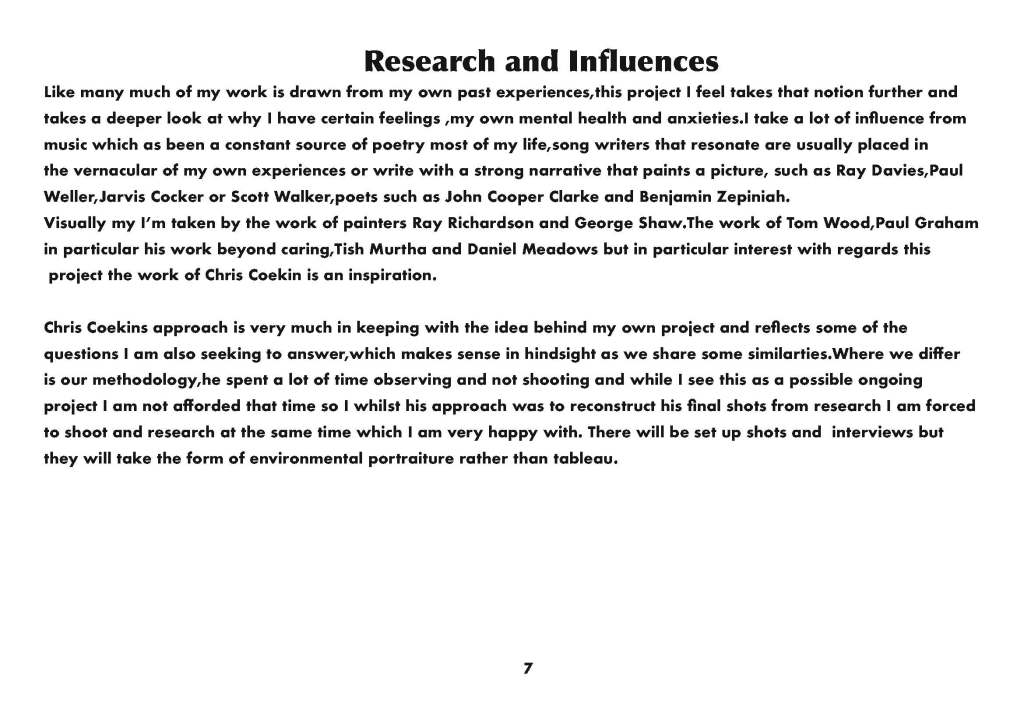
Moving on a little further ,whilst looking at the idea of repurposing photography for our course work I have been re investigating images my dad has of his parents and family including himself.His was not an easy upbringing,although on his mother side they were not poor his mother died when he was young leaving his father to look after him.Who shipped him off to an uncle at 15 to work.I did meet my grandad many times and now in retrospect I get the impression he was not very paternal.

I’m still in the early days of investigating but it made me question my sometimes tense relationship with my own dad and that of myself and my children,my son in particular with which I have a very good relationship.

I’m keen to explore this notion further alongside this whole area around community  and circumstance.So for the final part of this modules journey I have been re purposing old photographs of my father ,his parents and in particular his dad with the images of the estate pubs,this personalisation is bringing the idea to life and as help form the body of work into a coherent journey that I will present as my WIPP.

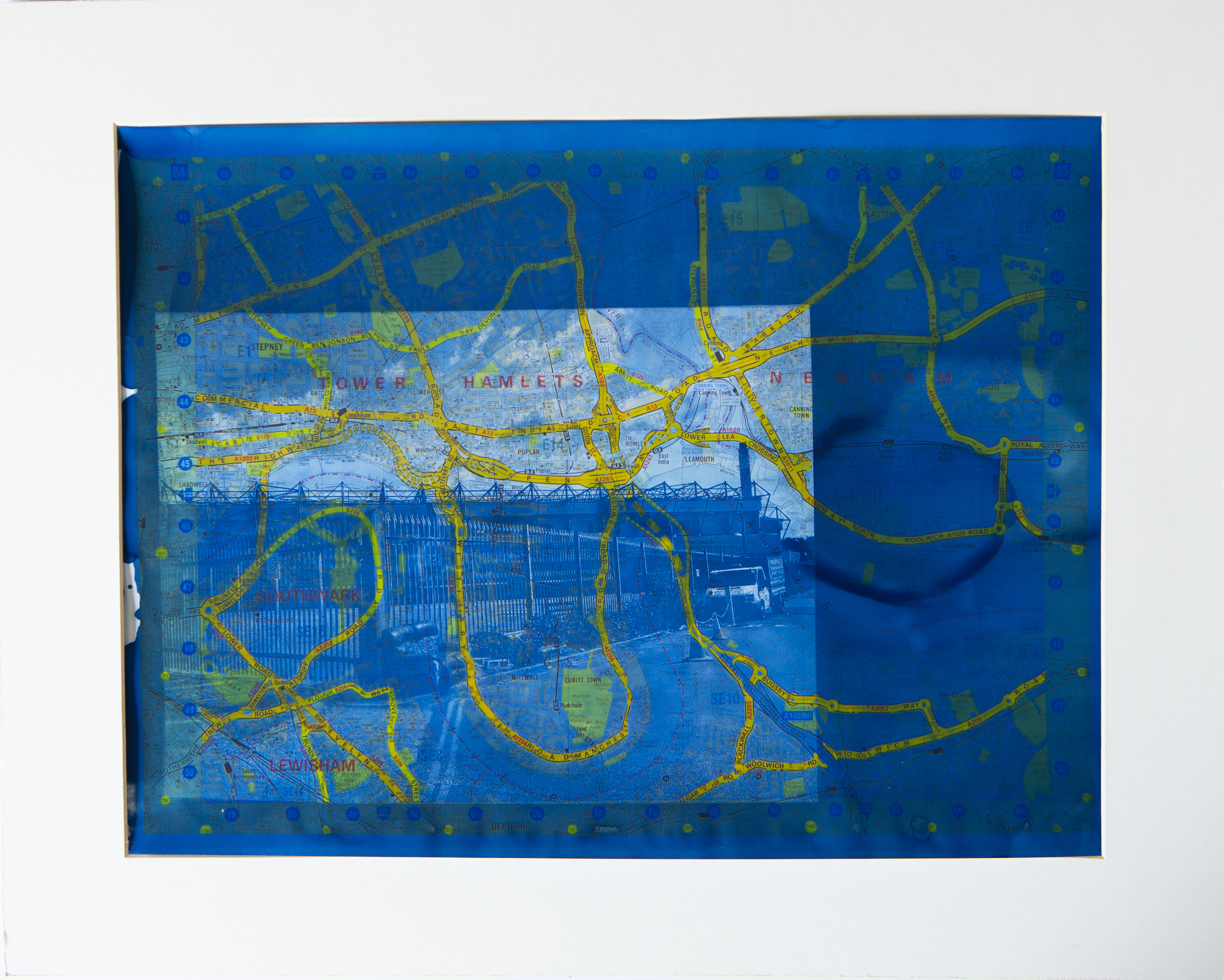
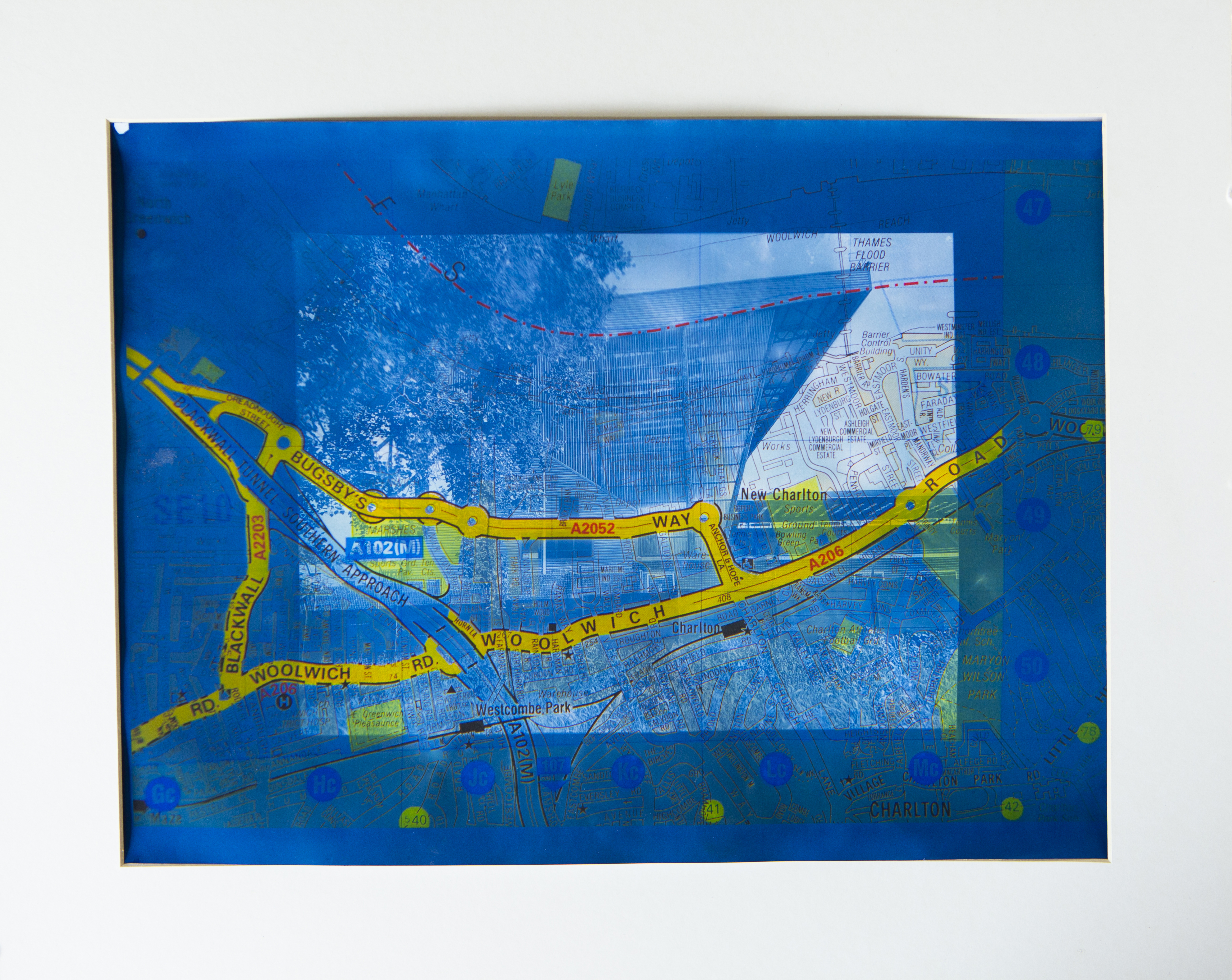
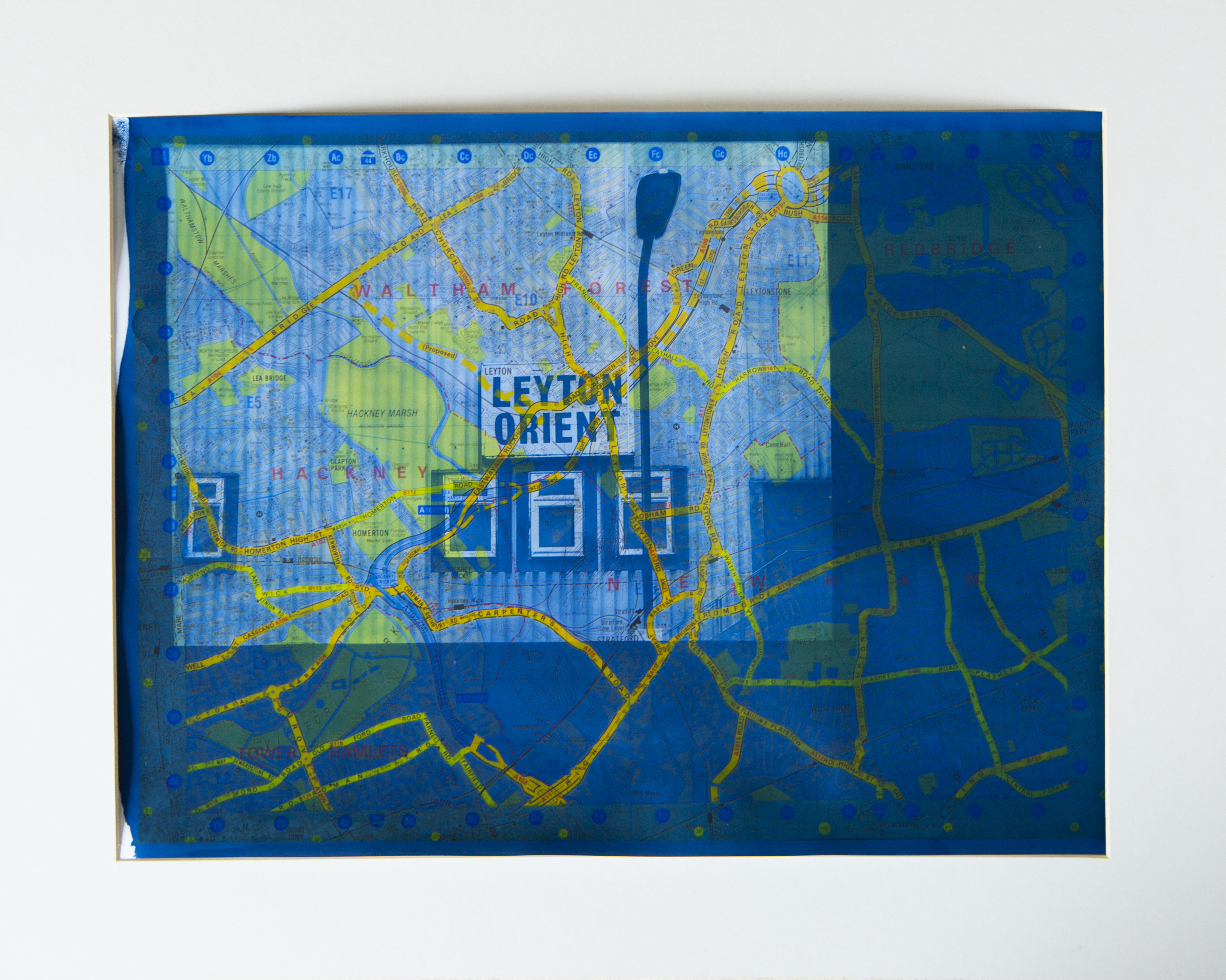
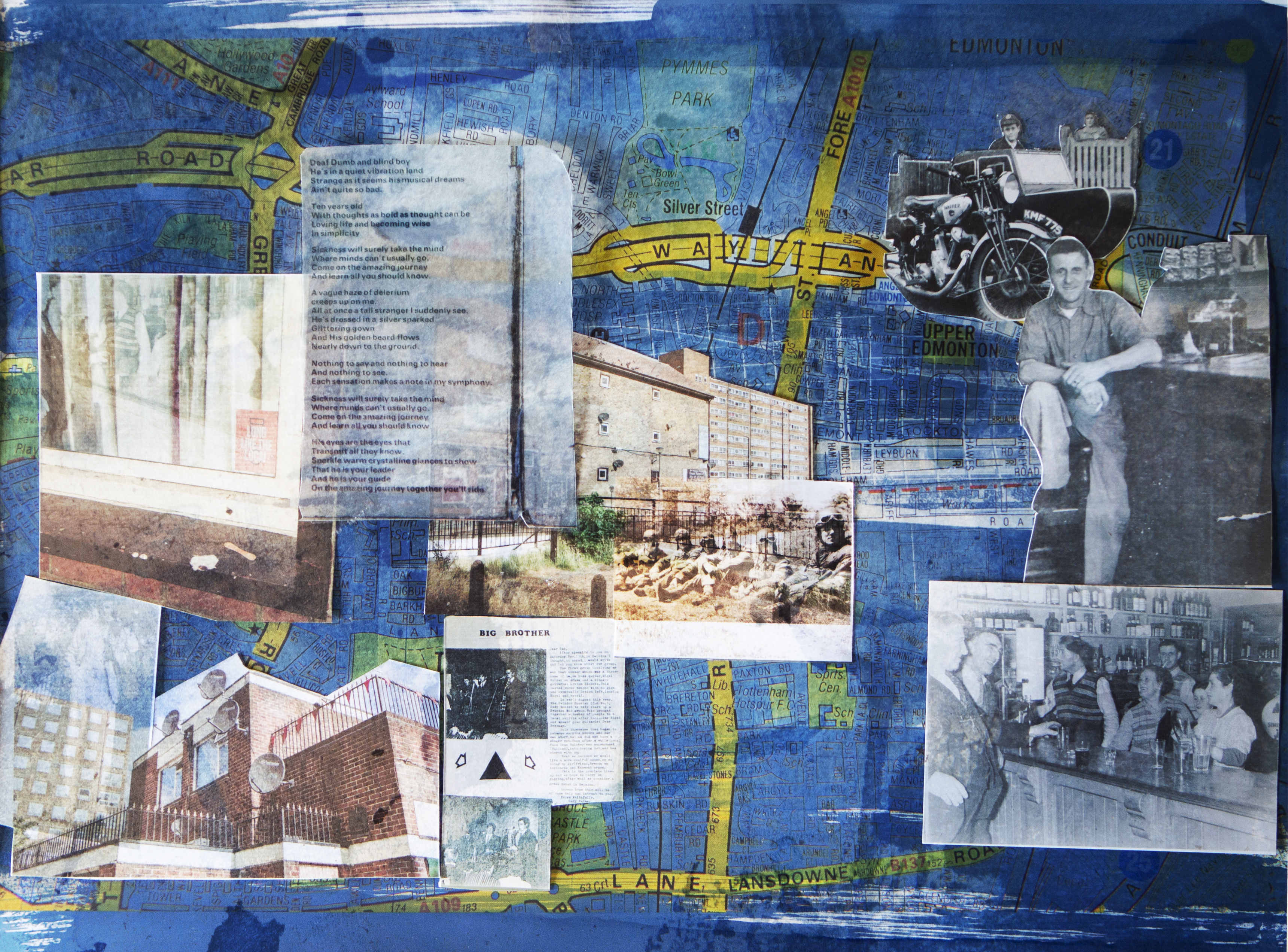
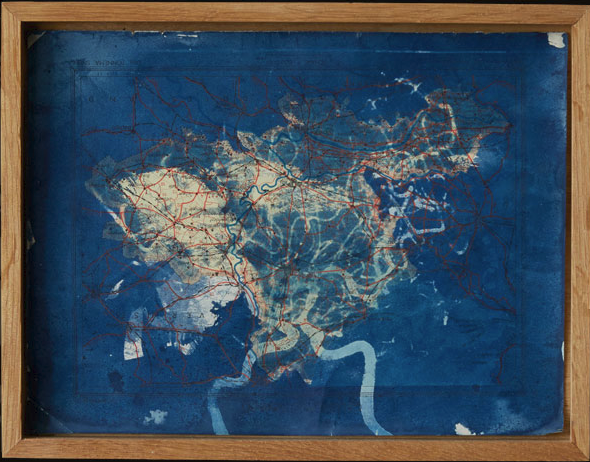
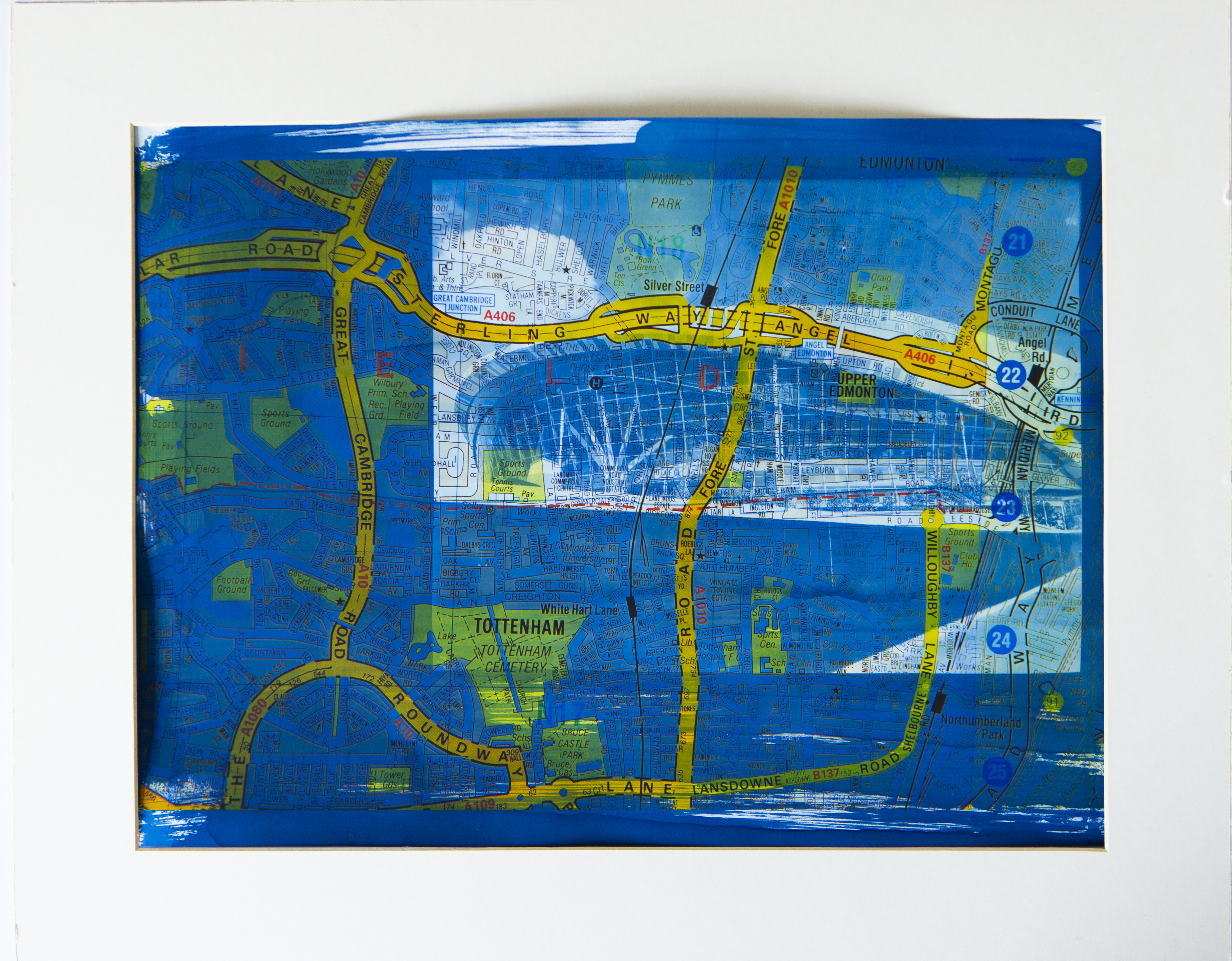
Simultaneously I am continuing to experiment with ideas around non lens. based photography (with differing degrees of success).Combining the ideas of Psychogeography with the use of maps,Cyanotype and cut ups/montage. Heavily influenced by Temporary Hoarding Magazine,the mouthpiece of Rock Against Racism from the days before Social Media,Rodchenko and his powerful Soviet era collages,Dziga Vertov and his Montage style in films such as the ground breaking Man with a Movie Camera and the use of books and pamphlets to get the ideas across.(Perhaps in itself a little nostalgic)
_D8A0767 copy

Heavily influenced by Barnaby Irish work Motivations. He wrote about the idea in the Essay Filaments and Knots The repeating Structure of Connections.I set about exploring my own experiences around my own connections.I experimented with his technique using maps and my work around football grounds and the journeys I took,the thoughts and ideas it evoked eventually using found imagery of myself,dad and grandad utilising the maps as a visual aid to that connection.
Screenshot 2020-08-10 at 20.31.05

_D8A0732_D8A0724_D8A0720_D8A0716


WIP


This is a link to a physical version of my Work in Progress in dummy book form. I particularly enjoyed this process of making,combining cyanotypes,montage Japanese stitching and the use of semi transparent overlays .


I now have a clear picture of how I will move on with this idea to my FMP.I intend to take some elements of the techniques used and explore further the use of oral history,re use of old imagery and moving image as projections. I like the idea of exploring the subject of nostalgia and the prevalence of its use in persuasion.

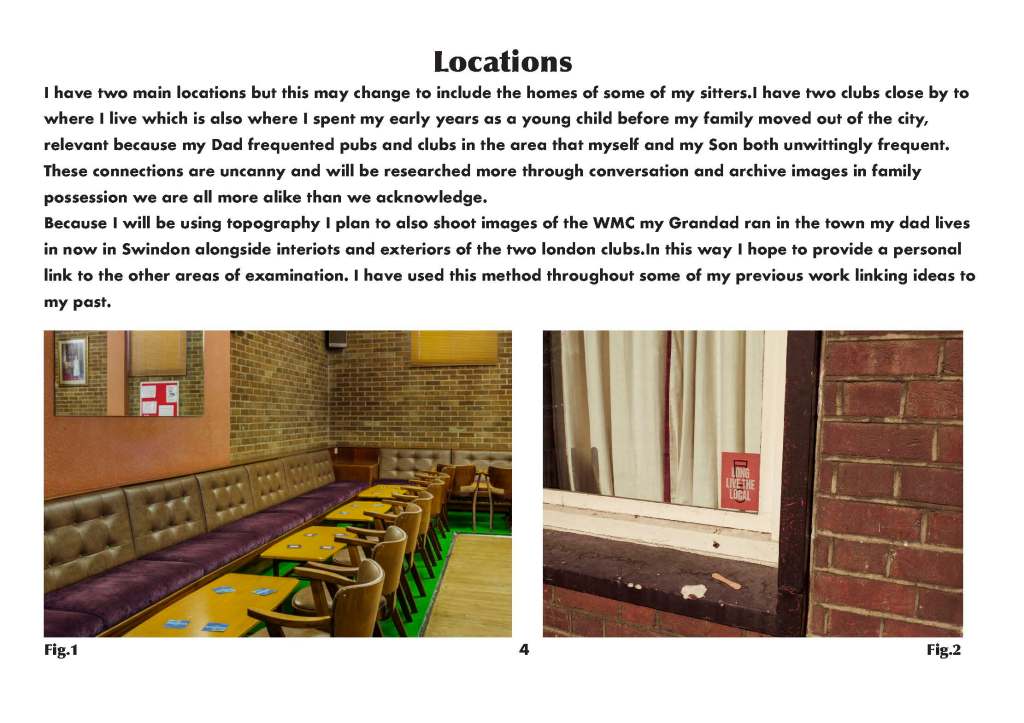
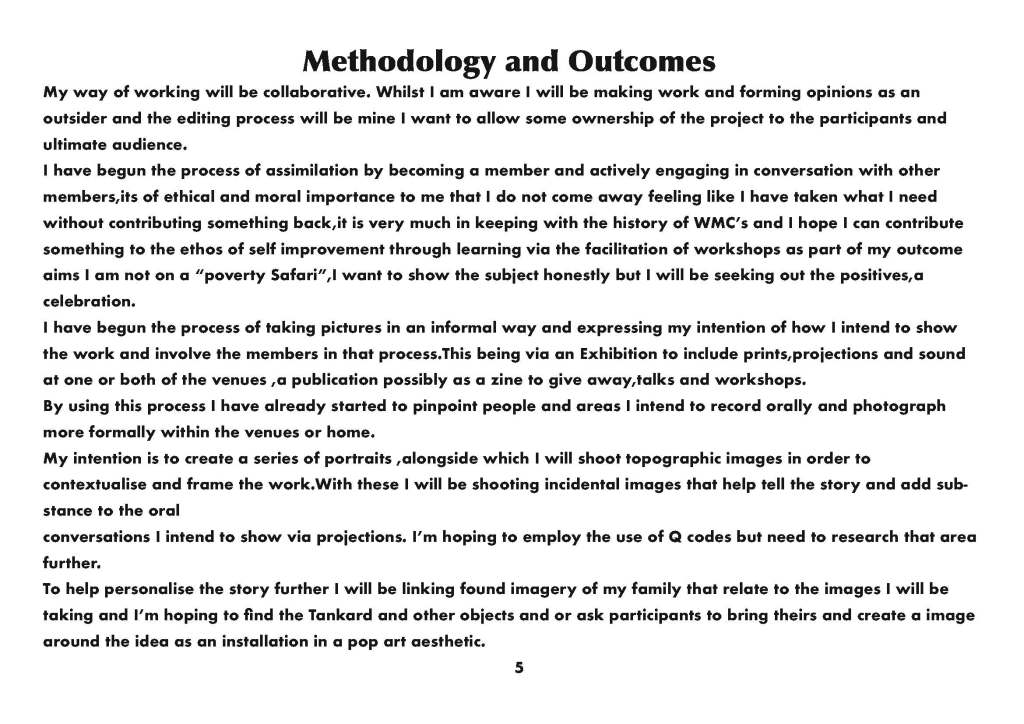
I am in contact with two local Working Mens Clubs and will be documenting the people,events and place over the next few months.I intend to interview informally as I assimilate into the group and relate these experiences to my own and my families.

I want to explore how these places fit within contemporary society now that there are so many alternative ways to be entertained and socialise,how as it affected community as a concept politically and culturally.

I’ll be exploring gender politics,racism,gentrification and the demise of the working class.

My Grandad was a steward of Working Mens Clubs and my dad was and still is an avid member. On my 18th birthday as tradition would have it I was bought membership (bearing in mind there would have been a long waiting list),I never ever used it.To me these places were of the past and of no interest to me. I’m older now and want to understand more.Maybe I have more in common with my past than I think.

References

A Q&A with… Laura Oldfield Ford, Artist and Urban Explorer – a-n The Artists Information Company. https://www.a-n.co.uk/news/a-qa-with-laura-oldfield-ford-artist-and-urban-explorer/. Accessed 12 Aug. 2020.
Archives and Collections | Oral History Society. https://www.ohs.org.uk/advice/archives-and-collections/. Accessed 13 Aug. 2020.
Barnaby Irish – 22 Artworks, Bio & Shows on Artsy. https://www.artsy.net/artist/barnaby-irish. Accessed 3 Aug. 2020.
Cherrington, Ruth. Not Just Beer and Bingo! A Social History of Working Men’s Clubs. AuthorHouse, 2012.
Coverley, Merlin. Psychogeography. 23rd ed., No Exit Press, 2018.
Détournement | Remixthebook. http://www.remixthebook.com/the-course/detournement-2. Accessed 2 Aug. 2020.
‘Estate Pubs’. London Pubology, 22 June 2008, https://pubology.wordpress.com/2008/06/22/estate-pubs/.
Gottschalk, Molly. ‘This Agoraphobic Photographer Uses Google Street View to Travel the World’. Artsy, 18 Apr. 2017, https://www.artsy.net/article/artsy-editorial-agoraphobic-photographer-google-street-view-travel.
Goulstone, John. ‘The Working‐class Origins of Modern Football’. The International Journal of the History of Sport, vol. 17, no. 1, Mar. 2000, pp. 135–43. Taylor and Francis+NEJM, doi:10.1080/09523360008714117.
‘How To Make Cyanotypes’. Parallax Photographic Coop, 24 May 2020, https://parallaxphotographic.coop/how-to-make-cyanotypes/.
Moakley, Paul. ‘Street View and Beyond: Google’s Influence on Photography’. Time, https://time.com/55683/street-view-and-beyond-googles-influence-on-photography/. Accessed 1 Aug. 2020.
Nostalgia and the Collapse of Imagination. https://petapixel.com/2015/09/10/nostalgia-collapse-imagination/#:~:text=Photography%20emphasizes%20nostalgia%20to%20visualize,brain%20that%20forms%20autobiographical%20memories. Accessed 16 Aug. 2020.
Rose, Jonathan. The Intellectual Life of the British Working Classes. 2nd ed, Yale University Press, 2010.
‘Stream of Consciousness’. Wikipedia, 4 June 2020. Wikipedia, https://en.wikipedia.org/w/index.php?title=Stream_of_consciousness&oldid=960735331.
The Story : Thamesmead. https://www.thamesmeadnow.org.uk/the-story/. Accessed 15 Aug. 2020.
‘’Traces and Pictures’’. David Campany, 28 Sept. 2011, https://davidcampany.com/traces-and-pictures/.
Wagner, Karin. ‘Nostalgic Photographs in the Contemporary Image Ecology: The Example of Tyrrells Crisp Packaging’. Journal of Aesthetics & Culture, vol. 10, no. 1, Jan. 2018, p. 1421375. Taylor and Francis+NEJM, doi:10.1080/20004214.2017.1421375.



References

A Q&A with… Laura Oldfield Ford, Artist and Urban Explorer – a-n The Artists Information Company. https://www.a-n.co.uk/news/a-qa-with-laura-oldfield-ford-artist-and-urban-explorer/. Accessed 12 Aug. 2020.
Archives and Collections | Oral History Society. https://www.ohs.org.uk/advice/archives-and-collections/. Accessed 13 Aug. 2020.
Barnaby Irish – 22 Artworks, Bio & Shows on Artsy. https://www.artsy.net/artist/barnaby-irish. Accessed 3 Aug. 2020.
Cherrington, Ruth. Not Just Beer and Bingo! A Social History of Working Men’s Clubs. AuthorHouse, 2012.
Coverley, Merlin. Psychogeography. 23rd ed., No Exit Press, 2018.
Détournement | Remixthebook. http://www.remixthebook.com/the-course/detournement-2. Accessed 2 Aug. 2020.
‘Estate Pubs’. London Pubology, 22 June 2008, https://pubology.wordpress.com/2008/06/22/estate-pubs/.
Gottschalk, Molly. ‘This Agoraphobic Photographer Uses Google Street View to Travel the World’. Artsy, 18 Apr. 2017, https://www.artsy.net/article/artsy-editorial-agoraphobic-photographer-google-street-view-travel.
Goulstone, John. ‘The Working‐class Origins of Modern Football’. The International Journal of the History of Sport, vol. 17, no. 1, Mar. 2000, pp. 135–43. Taylor and Francis+NEJM, doi:10.1080/09523360008714117.
‘How To Make Cyanotypes’. Parallax Photographic Coop, 24 May 2020, https://parallaxphotographic.coop/how-to-make-cyanotypes/.
Moakley, Paul. ‘Street View and Beyond: Google’s Influence on Photography’. Time, https://time.com/55683/street-view-and-beyond-googles-influence-on-photography/. Accessed 1 Aug. 2020.
Nostalgia and the Collapse of Imagination. https://petapixel.com/2015/09/10/nostalgia-collapse-imagination/#:~:text=Photography%20emphasizes%20nostalgia%20to%20visualize,brain%20that%20forms%20autobiographical%20memories. Accessed 16 Aug. 2020.
Rose, Jonathan. The Intellectual Life of the British Working Classes. 2nd ed, Yale University Press, 2010.
‘Stream of Consciousness’. Wikipedia, 4 June 2020. Wikipedia, https://en.wikipedia.org/w/index.php?title=Stream_of_consciousness&oldid=960735331.
The Story : Thamesmead. https://www.thamesmeadnow.org.uk/the-story/. Accessed 15 Aug. 2020.
‘’Traces and Pictures’’. David Campany, 28 Sept. 2011, https://davidcampany.com/traces-and-pictures/.
Wagner, Karin. ‘Nostalgic Photographs in the Contemporary Image Ecology: The Example of Tyrrells Crisp Packaging’. Journal of Aesthetics & Culture, vol. 10, no. 1, Jan. 2018, p. 1421375. Taylor and Francis+NEJM, doi:10.1080/20004214.2017.1421375.